
Guide · Saving & Banking · 6 min read
Is a High-Yield Savings Account Worth It? The Honest Math
A high-yield savings account can pay more than ten times what a typical bank pays, with the same insurance. Here's what that's really worth, the catches to watch for, and what it's the right home for.
Updated
The short answer
- In October 2026, no-strings high-yield savings accounts paid about 4.25% to 4.35% APY, versus a national average of about 0.37%.
- On $10,000, that's about $425 a year instead of $37, with the same FDIC or NCUA insurance up to $250,000.
- At 0.37%, inflation of about 3% shrinks your buying power every year; at about 4.25%, your savings roughly keep pace and grow a little.
- It's the right home for your emergency fund and short-term goals, not for retirement money you won't touch for decades.
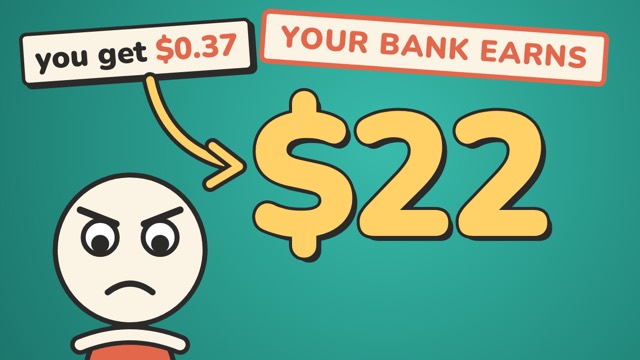
Watch: Lesson 3, How Banks Make Money: Your Bank Pays You 37¢ and Earns Up to $22 on Your $100
Watch the full lesson (10:04) or read the illustrated write-up below. Open on YouTube
Video chapters
- 0:00 Your $100 isn't in a vault
- 0:41 Intro
- 0:51 A deposit is a loan to your bank
- 1:19 The bank as middleman
- 1:47 The bank's two columns
- 2:29 The spread: $3.70 in, up to $220 out
- 3:34 Reserves: why the requirement is 0%
- 4:18 How banks create new money
- 5:08 Bank runs: the SVB story
- 5:36 FDIC insurance explained
- 6:21 Fees and the fine print
- 6:46 How a low rate quietly loses you money
- 7:32 Getting on the right side of the spread
- 8:22 The big picture
- 8:56 3 things to do this week
- 9:21 Recap & next lesson
If you keep your savings at a big traditional bank, there's a good chance it earns almost nothing. The national average savings rate was about 0.37% in 2026, according to the FDIC. Meanwhile, many online banks and credit unions paid around 4.25% APY on high-yield savings accounts, more than ten times as much, with the same federal insurance.
So is a high-yield savings account worth it? For most people's emergency fund and short-term savings, yes. But there are catches, and there's a point where a savings account stops being the right tool. This guide draws out the honest math.
What is a high-yield savings account?
A high-yield savings account (HYSA) is a regular savings account that pays a much higher interest rate than average. It works like any savings account: you deposit money, earn interest every month and can withdraw when you need to.
Most are offered by online banks or credit unions. Without large branch networks to pay for, they can afford to share more of the spread with savers, the gap between what a bank pays depositors and what it earns by lending. We draw out how that spread works in Lesson 3: your bank pays you about 37 cents a year on $100, while the same money lent on a credit card can earn the bank about $22.
What the higher rate is actually worth
Here's one year of interest at the national average versus a typical no-strings high-yield rate:
| Balance | At 0.37% (national average) | At 4.25% (high-yield) | Difference per year |
|---|---|---|---|
| $1,000 | about $4 | about $42 | about $38 |
| $5,000 | about $18 | about $213 | about $195 |
| $10,000 | about $37 | about $425 | about $388 |
| $25,000 | about $92 | about $1,062 | about $970 |
Over five years, $10,000 grows to about $10,186 at 0.37%, or about $12,313 at 4.25% (if rates stayed the same). That's roughly $2,100 more for moving your money to a different account once. Few money moves pay that well for ten minutes of work.
The real reason it matters: inflation
Prices tend to rise by around 3% a year over the long run. That turns a low savings rate into a slow loss:
| $10,000 after 5 years, in today's buying power (3% inflation) | |
|---|---|
| At 0.37% | about $8,800: you've lost buying power |
| At 4.25% | about $10,600: you've kept up and grown a little |
At the national average rate, your emergency fund quietly loses about $1,200 of buying power in five years without you ever noticing. A high-yield account doesn't make you rich, but it stops the leak.
Is a high-yield savings account safe?
Usually, yes, as long as you check one thing: insurance.
- Accounts at FDIC-insured banks are protected up to $250,000 per depositor, per insured bank, per ownership category. Since the FDIC began in 1934, no depositor has lost a penny of insured funds.
- Accounts at credit unions are protected the same way by the NCUA.
- Some apps and fintech companies aren't banks themselves; they hold your money at a partner bank. Check which bank holds your deposits and that it's insured, before you deposit.
An HYSA is a savings account, not an investment: its balance never drops because the stock market falls.
The catches to watch for
The rate is variable. HYSA rates move with the Federal Reserve's interest rates. If the Fed cuts rates, your APY usually falls too, sometimes within weeks. The rates above are a snapshot from October 2026, not a promise.
Teaser and conditional rates. Headlines with "up to 5%" usually come with strings: a promotional rate for a few months, a required linked checking account, a direct deposit or a balance cap. When the promo ends, the rate drops to the standard one. Compare the standard rate, not the headline.
Transfers take time. Moving money from an online bank to your checking account can take one to three business days. For truly instant needs, keep a small cushion in checking. Lesson 5 explains how to set up both.
Withdrawal limits. The old federal limit of six withdrawals a month was removed in 2020, but some banks still limit or charge for frequent withdrawals. Check the account terms.
Interest is taxable. Savings interest counts as ordinary income on your federal tax return; banks send a Form 1099-INT when you earn $10 or more. In the 22% bracket, about $94 of the $425 earned on $10,000 would go to federal tax. You still come out far ahead of 0.37%.
What a high-yield savings account is (and isn't) for
| Good fit | Not the best fit |
|---|---|
| Your emergency fund (3 to 6 months of essentials) | Retirement money you won't touch for 20+ years |
| Sinking funds for known costs: insurance, holidays, car repairs | Money you need for everyday spending (keep that in checking) |
| Short-term goals in the next few years: a car, a move, a down payment | Paying off a 22% credit card (pay the card first) |
For long-term goals, a savings account usually loses to investing. Over decades, the US stock market has averaged roughly 10% a year before inflation, compared with about 4% for today's best savings accounts, but with big ups and downs. That's why we keep the emergency fund in savings and invest for retirement, as drawn out in the smartest order to use your money. And if you carry a credit card balance at about 22%, paying it off beats any savings rate by a mile.
How to choose a high-yield savings account
- Check the insurance: FDIC (banks) or NCUA (credit unions), and the name of the partner bank if it's an app.
- Compare the standard APY, ignoring promotional boosts that expire.
- Look for no monthly fees and no minimum balance you might fall below.
- Check transfer times and withdrawal limits.
- Link it to your checking account and set up an automatic transfer for the day after payday.
Even rough numbers make the point: moving a $10,000 emergency fund from 0.37% to about 4.25% is worth nearly $400 a year. Our compound interest calculator shows what that looks like over time.
Frequently asked questions
Is a high-yield savings account worth it?
For most people's emergency fund and short-term savings, yes. In October 2026, no-strings high-yield accounts paid about 4.25% to 4.35% APY, compared with a national average around 0.37%. On $10,000, that's roughly $425 a year instead of $37, with the same FDIC or NCUA insurance.
Can you lose money in a high-yield savings account?
Not from market drops: it's a savings account, not an investment, so your balance doesn't fall when stocks do. Deposits at FDIC-insured banks are protected up to $250,000 per depositor, per bank, per ownership category. The main risks are inflation outpacing your rate and rates falling over time.
How much interest does $10,000 earn in a high-yield savings account?
At about 4.25% APY, roughly $425 in a year. At the national average of about 0.37%, about $37. Rates are variable and change with the Federal Reserve's policy rate.
What's the catch with high-yield savings accounts?
The rate is variable and can fall, headline rates may be promotional or conditional, transfers to checking can take one to three business days, some banks limit withdrawals, and the interest is taxable as ordinary income.
Should I keep my emergency fund in a high-yield savings account?
For most people, it's a good fit: safe, insured, easy to reach within a few days and earning far more than an average account. Keep a small amount in checking for same-day needs.
Is a high-yield savings account better than investing?
They do different jobs. A savings account is for money you may need soon and can't afford to see drop. Investing, for example in low-cost index funds, is for long-term goals like retirement, where higher average returns are worth the ups and downs.
Sources
National average savings rate about 0.37% (FDIC national rate, via FRED series SNDR; 0.38% in mid-2026). High-yield rates are a snapshot from roundups published October 5 to 14, 2026 (NerdWallet, The Motley Fool, The College Investor): no-strings accounts around 4.25% to 4.35% APY, promotional or conditional offers up to about 5%. Rates change frequently; check each bank before opening an account. FDIC deposit insurance: $250,000 per depositor, per insured bank, per ownership category; no depositor has lost FDIC-insured funds since 1934. The six-withdrawal limit on savings accounts (Regulation D) was removed by the Federal Reserve in April 2020; banks may set their own limits. Savings interest is taxable as ordinary income; banks issue Form 1099-INT for $10 or more (IRS). Calculations assume interest compounding at the stated APY with no deposits or withdrawals; the inflation example assumes 3% a year. No bank or account is recommended.
Money, explained one sketch at a time
Every guide comes from a full video lesson. Subscribe on YouTube so you don't miss the next one.
Subscribe on YouTube See all lessonsThe full lessons
Lesson 3 · Saving & Banking
How Banks Make Money: Your Bank Pays You 37¢ and Earns Up to $22 on Your $100
Your $100 isn't sitting in a vault. Here's what your bank actually does with it, how the spread turns 37 cents into up to $22, and how to get on the right side of the deal.
Lesson 5 · Saving & Banking
The Emergency Fund, Explained: How Much You Need and Where to Keep It
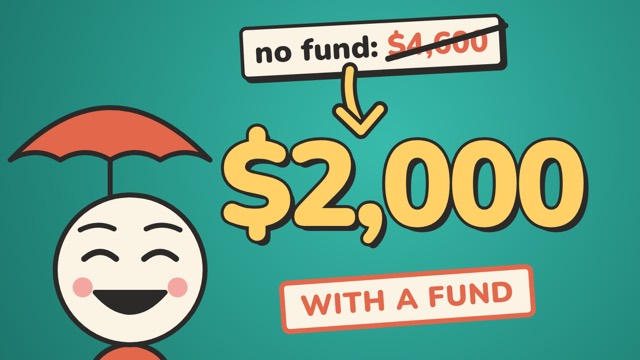
The same $2,000 car repair costs about $4,600 on a credit card and exactly $2,000 with an emergency fund. Here's how much you need, where to keep it and how to start when money is tight.