
Lesson 3 · Saving & Banking · 10 min read · 10:04 video
How Banks Make Money: Your Bank Pays You 37¢ and Earns Up to $22 on Your $100
Your $100 isn't sitting in a vault. Here's what your bank actually does with it, how the spread turns 37 cents into up to $22, and how to get on the right side of the deal.
Updated
Watch the full lesson (10:04) or read the illustrated write-up below. Open on YouTube
The lesson in 30 seconds
- A deposit is really a loan to your bank. Your balance is the bank's promise to pay you back on demand.
- The average US savings account pays about 0.37% a year: 37¢ on $100. The same money lent on a credit card can earn the bank about $22.
- The US reserve requirement has been 0% since March 2020, and reserves at the Fed earn 3.90%.
- When banks make loans they create new money, and FDIC insurance protects deposits up to $250,000 per depositor, per bank, per ownership category.
- At a 0.37% rate with 3% inflation, $1,000 of savings loses about $25 of buying power a year. A ~4% high-yield account earns about $40 instead of $3.70.
You put $100 into a savings account. Where is it right now?
Most people picture a vault: rows of cash, a heavy steel door, your $100 sitting on a shelf with your name on it. It isn't there. Your bank is probably using that money right now. Maybe it's part of someone's mortgage. Maybe it's parked at the central bank, earning interest. Maybe it's paying for a car repair on somebody's credit card.
And here's the part that stings. On average, a US savings account pays about 37 cents a year on that $100. The bank can earn several dollars on the same money, and sometimes more than $22.
In this lesson we draw out how banks make money: where your deposit goes, how the spread works, why there's no reserve requirement anymore, the surprising way banks create new money, and how to make sure you're on the right side of the deal.
Your $100 isn't in a vault
Banks do keep some cash: enough for ATMs, tellers and people who walk in to withdraw. But it's a tiny slice of what customers have deposited.
So what is your balance? When you deposit money you're not renting a safety box; you're lending your money to the bank. Your balance is the bank's promise: "We owe you this much, and you can ask for it whenever you want."
That's why a deposit is really a loan. You're the lender, the bank is the borrower. And like any borrower, the bank pays you interest. Just not very much.
The bank as a middleman
Here's the simple picture most of us learned. Lots of people deposit money. The bank pools it, then lends it to people who need it:
- a family buying a house gets a mortgage
- someone buys a car with a car loan
- a small bakery borrows to buy a new oven
- people like Sam from Lesson 2 carry a credit card balance
The bank also parks money in very safe places, such as government bonds and its own account at the central bank, which in the US is the Federal Reserve.
So the bank sits in the middle, savers on one side and borrowers on the other. Its balance sheet has two columns: what it owes (your deposits) and what it owns (loans, bonds and reserves). The whole business comes down to one word.
The spread: 37¢ in, up to $22 out
The spread is the difference between what the bank pays savers and what it charges borrowers. Here are real US numbers from September 2026:
| What | Typical rate | On $100 per year | On $1,000 per year |
|---|---|---|---|
| Average savings account (bank pays you) | 0.37% | $0.37 | $3.70 |
| 30-year fixed mortgage (borrower pays bank) | about 6.95% | about $6.95 | about $69.50 |
| Credit card balance (borrower pays bank) | about 22% | about $22 | about $220 |
Follow $1,000 of savings. The bank pays the saver about $3.70 a year. If that money helps fund a mortgage, the bank collects close to $70. If it ends up as credit card debt, that's about $220.
Of course, the bank has real costs: branches, staff, technology and borrowers who never pay back. But even after all that, the model works very well. Across all FDIC-insured US banks, the net interest margin (roughly, the spread after paying depositors, as a share of everything they own) was about 3.32% in Q2 2026. That sounds small until you remember how much banks own. In that quarter alone, US banks earned about $90 billion in profit. In three months.
Reserves: why the requirement is 0%
How much of your money does the bank have to keep on hand?
For decades, US banks had to keep a set percentage of certain deposits in reserve. But since March 26, 2020, the Federal Reserve's reserve requirement has been zero percent.
That doesn't mean banks keep nothing. They still need cash and reserves for withdrawals, and they face other rules about capital and liquidity. But there's no fixed percentage they must set aside.
Here's a detail most people never hear: the reserves banks hold at the Federal Reserve earn interest too. As of September 17, 2026, that rate is 3.90%. So a bank can pay you around a third of one percent, park money at the Fed and earn more than ten times as much.
Nobody is breaking a rule. It's simply how the system works. But it's worth knowing which side of it you're on.
How banks create new money
Now for the part that surprises even many economists. The simple picture says savers deposit money and the bank lends it out. It's not quite that simple.
When a bank makes a loan, it usually doesn't take cash out of someone else's account. It creates a brand-new deposit.
Go back to Sam's car repair. When Sam tapped a credit card for $2,000, the bank paid the garage. The garage's account went up by $2,000, but nobody's savings account went down. That $2,000 was new money, created by the loan. When Sam pays the loan back, that money disappears again.
This isn't a conspiracy theory. The Bank of England explained it in a well-known 2014 paper, Money creation in the modern economy: most of the money in the modern economy is created by commercial banks when they make loans.
Banks can't do this without limits. They need enough capital, borrowers who can repay, and regulators watching them. But it means your bank isn't just a middleman. It's quite literally a money-making machine.
Bank runs: what if everyone wants their money back?
If your money isn't in a vault, what happens if everyone asks for it at the same time? That's a bank run, and it's not just history-book stuff.
On March 9, 2023, customers of Silicon Valley Bank tried to withdraw about $42 billion in a single day, much of it through phone apps as worried messages spread online. The bank couldn't pay everyone fast enough, and regulators closed it the next morning.
No bank keeps enough cash for everyone to leave at once. That's exactly why deposit insurance exists.
FDIC insurance, explained
In the US, deposit insurance comes from the FDIC, the Federal Deposit Insurance Corporation. If your bank is FDIC-insured and it fails, your deposits are protected up to $250,000 per depositor, per insured bank, for each ownership category (for example, individual accounts, joint accounts and certain retirement accounts are separate categories).
According to the FDIC, since it began in 1934, no depositor has ever lost a penny of insured funds. So for most people, a savings account at an insured bank is one of the safest places money can be.
Credit unions have a similar system run by the NCUA.
Fees and the fine print
Interest isn't the only way banks make money from you. There are also fees:
- monthly maintenance fees on some checking and savings accounts
- overdraft fees when you spend more than you have
- ATM fees when you use another bank's machine
And every time you tap a card at a store, the store pays a processing fee, commonly around 1.5% to 3.5%. That's one reason cards offer rewards: part of that fee comes back to you, to keep you tapping.
None of this is secret. It's all in the fine print. But the fine print is long, and banks know most people won't read it.
How a low savings rate quietly loses you money
Why does any of this matter? Because a low interest rate isn't just small. Over time, it can quietly lose you money.
Prices tend to rise every year. Over the long run, US inflation has averaged roughly 3% a year. Imagine you keep a $1,000 emergency fund in an account paying 0.37%:
| After one year | |
|---|---|
| Your balance | about $1,003.70 |
| What $1,000 of stuff now costs (3% inflation) | $1,030 |
| Your real buying power | about $25 less than a year ago |
Your money grew by less than $4. Prices grew by $30. Nothing was stolen and nobody sent you a bill. It just leaked away, a little at a time. Use the Rule of 72 to see it another way: at 0.37%, your money takes nearly 200 years to double.
Getting on the right side of the spread
So how do you get on the right side?
Step 1: shop around for your savings rate. Many online banks and credit unions offer high-yield savings accounts. In September 2026, some of the best paid around 4%, often with no monthly fees. Rates change all the time, so always check the current number. On the same $1,000 emergency fund, 4% is about $40 a year instead of $3.70: same safety if the account is insured, more than ten times the interest. Lesson 5 explains how much to keep there.
Step 2: kill the fees. Look for accounts with no monthly fee, and turn on low-balance alerts so you never pay an overdraft.
Step 3: don't be the bank's favorite customer. The person paying 22% on a credit card is where the bank earns the most. Every dollar of expensive debt you pay off moves you from that side of the spread toward the saver's side.
The big picture
Banks aren't villains. They keep money safe, move payments around the world in seconds, and their loans help people buy homes and build businesses. But a bank is a business, and a big part of its profit is the gap between what it pays you and what it charges someone else.
Think back to our two friends. Alex invests every month and lets compound interest work in Alex's favor. Sam, paying only the minimum, was on track to send the bank about $2,600 in interest. Same bank, same system, two completely different sides of it.
The goal isn't to avoid banks. It's to use them on purpose.
Three things to do this week
- Find your savings rate. Log into your bank app and look up the interest rate on your savings account. If it starts with "0.", write it down.
- Compare it with a few FDIC-insured high-yield savings accounts or credit unions. If the gap is big, consider moving your emergency fund.
- Add up your fees. Check your statements for monthly, overdraft and ATM fees, and total them for the year. That number might surprise you.
Frequently asked questions
What do banks do with the money you deposit?
Banks use deposits to fund loans such as mortgages, car loans, business loans and credit card balances, and they hold some in safe assets like government bonds and reserves at the Federal Reserve. They keep only a small amount as physical cash for withdrawals.
How do banks make money?
Mainly from the spread: they pay savers a low rate and charge borrowers a higher one. In September 2026 the average savings rate was about 0.37%, while mortgages were near 7% and credit cards about 22%. Banks also earn fees from accounts, overdrafts, ATMs and card transactions.
Do banks have to keep a percentage of deposits in reserve?
Not in the US anymore. The Federal Reserve cut the reserve requirement to 0% on March 26, 2020. Banks still hold reserves and cash to meet withdrawals, and they must follow capital and liquidity rules.
Is my money safe in a bank?
At an FDIC-insured bank, deposits are protected up to $250,000 per depositor, per insured bank, for each ownership category, and no depositor has lost insured funds since 1934. Credit union deposits are protected in a similar way by the NCUA. Check that an app or online bank is actually insured or partnered with an insured bank.
What is a good interest rate for a savings account?
The national average was about 0.37% in September 2026, while competitive high-yield savings accounts paid around 4%. Rates move with the Federal Reserve's policy rate, so compare current offers and watch for fees or balance requirements.
Do banks really create money when they lend?
Yes. When a bank makes a loan, it typically creates a new deposit in the borrower's account rather than handing out other customers' cash. The Bank of England described this in its 2014 paper "Money creation in the modern economy." Capital rules, regulation and demand for loans limit how much banks can lend.
Assumptions and sources
Rates as of September 2026: FDIC national savings rate 0.37% (via FRED, series SNDR); Freddie Mac Primary Mortgage Market Survey, 30-year fixed 6.95% (Sept 17, 2026); Federal Reserve G.19, credit card APR 22.15% on accounts assessed interest (Q2 2026); FDIC Quarterly Banking Profile Q2 2026 (net interest margin 3.32%, net income $90.1 billion); Federal Reserve Board (reserve requirement 0% since March 26, 2020; interest on reserve balances 3.90% from Sept 17, 2026); Bank of England Quarterly Bulletin 2014 Q1, "Money creation in the modern economy"; FDIC deposit insurance rules; Bankrate high-yield savings survey (September 2026). Inflation example assumes 3% for one year. Rates change over time.
One new lesson every week
Each lesson builds on the one before. Subscribe on YouTube so you don't miss the next one.
Subscribe on YouTube See all lessonsKeep learning
Lesson 5 · Saving & Banking
The Emergency Fund, Explained: How Much You Need and Where to Keep It
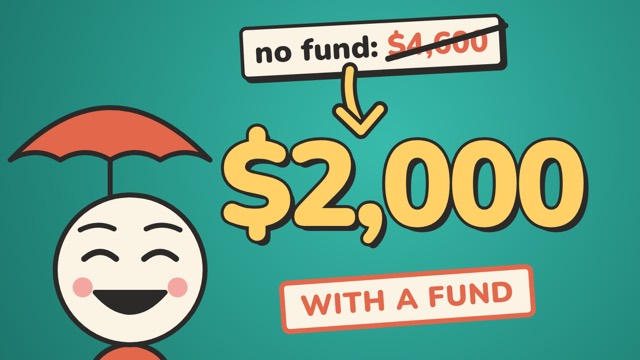
The same $2,000 car repair costs about $4,600 on a credit card and exactly $2,000 with an emergency fund. Here's how much you need, where to keep it and how to start when money is tight.
Lesson 1 · Investing
What Happens If You Invest $100 a Month? The Honest Math
You put in $48,000. You could walk away with about $262,000. Here is exactly where the other $214,000 comes from, and why waiting ten years costs more than $140,000.
Lesson 2 · Credit & Debt
The Credit Card Minimum Payment Trap: How $2,000 Becomes $4,600
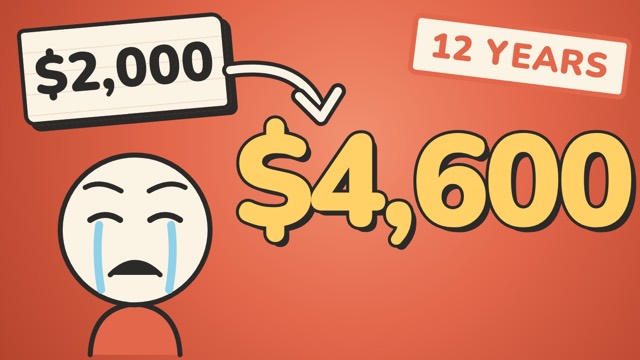
Pay only the minimum on a $2,000 card and it takes almost 12 years and about $2,600 in interest to clear. Here is where every payment really goes, and three ways to escape.