
Lesson 4 · Credit & Debt · 10 min read · 9:58 video
Your Credit Score, Explained: How It Works and How to Build One From Zero
A three-digit number helps decide your apartment, your car loan and your mortgage rate. Here's what goes into it, what drags it down, and how to build good credit from zero.
Updated
Watch the full lesson (9:58) or read the illustrated write-up below. Open on YouTube
The lesson in 30 seconds
- A credit score is a prediction of how likely you are to repay borrowed money. FICO scores run from 300 to 850; the US average is about 714.
- On a $300,000, 30-year mortgage, 6.5% vs 8% is about $305 a month, close to $110,000 over the life of the loan.
- Two ingredients make up about 65% of your FICO score: paying on time (35%) and amounts owed (30%).
- Keep credit utilization under 30%, ideally under 10%. Unlike late payments, it has no long memory.
- No credit? Start with a secured card, becoming an authorized user or a credit-builder loan, then use a little and pay on time every month.
There's a three-digit number that follows you everywhere. You've probably never seen it and you didn't choose it, but it helps decide whether you get the apartment, what you pay for a car loan and how much your mortgage will cost.
Two people can buy the exact same house for the exact same price, and one pays about $300 a month more than the other, for thirty years. That can add up to more than $100,000. The only real difference between them is that three-digit number: their credit score.
In this lesson we draw out what a credit score actually measures, the five ingredients that make it up, the mistakes that quietly drag it down, and how to build good credit from scratch, even if you're starting at zero.
What a credit score really is
A credit score is a prediction. It's a single number that tries to answer one question for a lender: if we lend this person money, how likely are they to pay it back on time?
The most common one in the US is the FICO score, which runs from 300 to 850. Higher is better. As of 2026, the average FICO score in the US is about 714.
Where does the number come from? From your credit reports. Three big companies, called credit bureaus (Equifax, Experian and TransUnion), keep a record of how you handle borrowed money. Every card, every loan and every payment, on time or late, can end up in those reports. A formula then reads your report and turns your whole borrowing history into one number.
It doesn't know your salary, and it doesn't care how much you have in savings. It only looks at how you've handled credit.
Why it matters: same house, different price
Lenders use your score to set your price. A higher score usually means lower interest rates. A lower score means higher rates, bigger deposits or sometimes a flat "no".
Here's an illustration. Two people each borrow $300,000 on a 30-year fixed mortgage:
| Strong score | Weaker score | |
|---|---|---|
| Interest rate (illustrative) | 6.5% | 8.0% |
| Monthly payment | about $1,896 | about $2,201 |
| Difference per month | about $305 | |
| Difference over 30 years | about $109,800 |
Same house, same loan, a different number.
And it's not just mortgages. Your credit can come up when you rent an apartment, finance a car or, in some places, set up utilities or a phone plan. In most US states, car insurers are also allowed to use credit-based information when setting your premium. So this one number quietly touches your rent, your car, your insurance and your home.
The 5 ingredients of your FICO score
FICO breaks the score into five ingredients. Picture them as slices of a pie:
| Ingredient | Share of score | The question it asks |
|---|---|---|
| Payment history | about 35% | Do you pay on time? |
| Amounts owed | about 30% | How much of your available credit are you using? |
| Length of credit history | about 15% | How long have your accounts been open? |
| New credit | about 10% | Have you opened many new accounts recently? |
| Credit mix | about 10% | Do you handle different kinds of credit, like a card and a loan? |
Notice something: almost two-thirds of the score comes from just two things, paying on time and not using too much of your credit. Get those two right and you're most of the way there.
Payment history: the biggest slice
Payment history is simple but brutal. Paying late can hurt more than almost anything else.
The good news: a payment that's a few days late usually isn't reported to the credit bureaus. It generally shows up once it's 30 days or more past due. You may still owe a late fee, but your score has a little time.
The bad news: once a late payment is reported, it can stay on your credit report for up to seven years. Its impact fades over time, but it doesn't disappear overnight.
So the single most powerful thing you can do for your score is also the most boring: never miss a payment. The easiest way to guarantee that is to set up autopay, at least for the minimum, and then pay more by hand. Remember Lesson 2: the minimum is a safety net, not a plan.
Credit utilization, explained
The second-biggest slice is amounts owed, and the key idea has a clunky name: credit utilization. It's how much you owe on your cards divided by your total credit limits.
| Card balance | Credit limit | Utilization | |
|---|---|---|---|
| Sam, after the car repair | $2,000 | $2,500 | 80% |
| Alex, at statement time | $200 | $4,000 | 5% |
To a lender, 80% looks like someone who's stretched thin. Even if Sam never misses a payment, that high balance can pull the score down.
A common rule of thumb is to keep utilization below 30%. People with the very highest scores often keep it under 10%.
Here's the part most people don't know: utilization is usually based on the balance your card company reports, which is often your statement balance. So even if you pay in full every month, a big balance on the statement can still show up as high utilization. The fix is to pay down the card before the statement closes, or keep your spending well below the limit.
And there's a bonus. Unlike a late payment, utilization has no long memory. Pay the balance down and your score can recover as soon as the lower balance is reported.
Length of history, new credit and credit mix
Now the smaller slices.
Length of credit history. Older accounts help. That's why people say: don't rush to close your oldest card, especially if it has no annual fee. Closing it can shorten your history and lower your total available credit, which pushes utilization up.
New credit. When you apply for a card or a loan, the lender usually makes a hard inquiry. One or two are no big deal, but many applications in a short time can look like you're desperate for credit. Hard inquiries stay on your report for two years, but FICO counts them only for the first twelve months.
Credit mix. Having both cards and loans can help a little. But never take a loan you don't need just to improve your mix. It's only about 10% of the score, and paying interest to chase it makes no sense.
How to build credit from zero
What if you have no credit history at all? Maybe you're young, new to the country or you've always paid cash. Then you face a frustrating problem: you need credit to build credit. Here are three common ways in.
- A secured credit card. You put down a deposit, often a few hundred dollars, which usually becomes your credit limit. Use it like a normal card and pay on time, and it builds your history. Many secured cards let you graduate to a regular card later.
- Become an authorized user. If a parent or partner has a card with a long, clean history and a low balance, they can add you to it. Their good habits can help your file, but their bad habits can hurt it too.
- A credit-builder loan, often offered by credit unions. The money goes into a locked savings account, you make monthly payments, and when you finish you get the money back. The payments are reported, and your history grows.
Whichever you choose, the rules are the same: use a little, pay on time, every single month.
How to check your credit reports for free
Everyone should do this, even people with good credit. In the US you can get free credit reports from all three bureaus every week at AnnualCreditReport.com, the official site.
A credit report looks intimidating, but it's really four sections:
- Personal details, like your name and addresses
- Accounts, with balances and payment history
- Inquiries, meaning who has checked your credit
- Public records and collections
Look for accounts you don't recognize, late payments you know you made on time, or wrong balances. Mistakes happen, and you have the right to dispute errors with the credit bureau. This is also one of the best ways to spot identity theft early: if someone opens a card in your name, it shows up here.
Credit score myths
Myth: you need to carry a balance to build credit. False. You never need to pay interest to build a score. Paying your statement in full is just as good for your score and far better for your wallet.
Myth: your income affects your score. It doesn't. Your salary isn't part of the formula. A lender may ask about income, but that's separate from the score.
Myth: using your debit card builds credit. It doesn't. A debit card spends your own money, so there's no borrowing to report. Rent and utility payments usually don't count either, unless they're specially reported.
Myth: you have one credit score. You actually have many. Different FICO versions and a competing model called VantageScore can give slightly different numbers. Don't panic if they don't match; the habits that raise one raise them all.
Sam and Alex: two wins, one decision
Let's check in on our two friends.
Sam has been paying the minimum on that $2,000 balance and never misses a payment, which is great. But 80% utilization is a heavy weight. If Sam follows the plan from Lesson 2, paying a fixed $200 a month and adding no new charges, the balance is gone in about a year. Utilization drops toward zero, and Sam's score can climb as the new balances are reported. The same move that saves Sam more than $2,000 in interest also improves Sam's credit score. Two wins, one decision.
Alex just keeps doing the boring things: pays in full, keeps the balance low, keeps the old card open. Nothing exciting. But years later, when Alex applies for a mortgage, that boring history turns into a lower rate and a smaller payment every month. (We compare renting and buying in Lesson 12.)
Three things to do this week
- Pull your free reports from all three bureaus at AnnualCreditReport.com. Check every account and dispute anything that's wrong.
- Turn on autopay for at least the minimum on every card and loan. One missed payment is the most expensive mistake on this list.
- Find your utilization. Add up your card balances and divide by your total limits. Above 30%? Make a plan to bring it down. No credit yet? Look into a secured card or a credit-builder loan at a credit union.
Frequently asked questions
What is a good credit score?
On the FICO scale of 300 to 850, scores in the high 600s and above are generally considered good, and scores above 740 to 800 usually qualify for the best rates. The US average was about 714 in 2026. Exact cutoffs vary by lender and loan type.
What affects your credit score the most?
Payment history (about 35% of a FICO score) and amounts owed, including credit utilization (about 30%). Paying every bill on time and keeping card balances low relative to your limits have the biggest impact.
What is credit utilization and what percentage should I keep it under?
Credit utilization is your total card balances divided by your total credit limits. A common guideline is to keep it under 30%, and people with the highest scores often stay under 10%. Because it's based on reported balances, paying down cards before the statement date can help.
Does checking your credit score lower it?
No. Checking your own score or report is a soft inquiry and has no effect. Hard inquiries, which happen when you apply for new credit, can lower your score slightly for up to 12 months in FICO's calculation.
How long do late payments stay on your credit report?
Late payments are generally reported once they are 30 or more days past due and can stay on your credit report for up to seven years. Their effect on your score fades over time, especially if you keep paying on time afterwards.
How can I build credit with no credit history?
Common options are a secured credit card, being added as an authorized user on a trusted person's well-managed card, or a credit-builder loan from a credit union. Use a small amount of credit and pay on time every month.
Does income affect your credit score?
No. Income is not part of the FICO or VantageScore formulas. Lenders may ask about your income separately when deciding whether to approve a loan.
Assumptions and sources
FICO score ingredients: myFICO, "What's in my FICO Scores" (payment history 35%, amounts owed 30%, length of credit history 15%, new credit 10%, credit mix 10%). Average FICO Score 714: FICO Score Credit Insights report, fall 2026. Free weekly credit reports: Federal Trade Commission and AnnualCreditReport.com. Late payment and inquiry reporting periods: Experian, CFPB and myFICO. The mortgage example ($300,000 over 30 years at 6.5% vs 8%) is an illustration, not current rates by credit score. FICO® is a registered trademark of Fair Isaac Corporation. Sam and Alex are illustrative examples.
One new lesson every week
Each lesson builds on the one before. Subscribe on YouTube so you don't miss the next one.
Subscribe on YouTube See all lessonsKeep learning
Lesson 2 · Credit & Debt
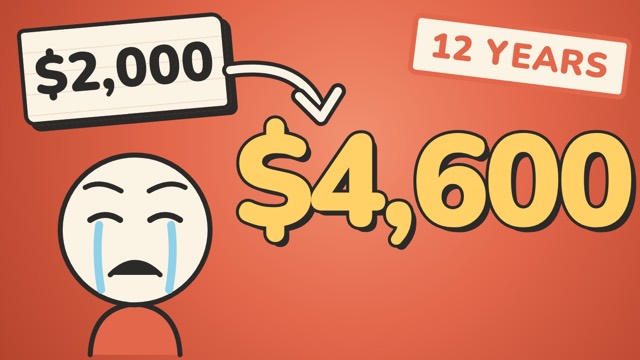
The Credit Card Minimum Payment Trap: How $2,000 Becomes $4,600
Pay only the minimum on a $2,000 card and it takes almost 12 years and about $2,600 in interest to clear. Here is where every payment really goes, and three ways to escape.
Lesson 1 · Investing
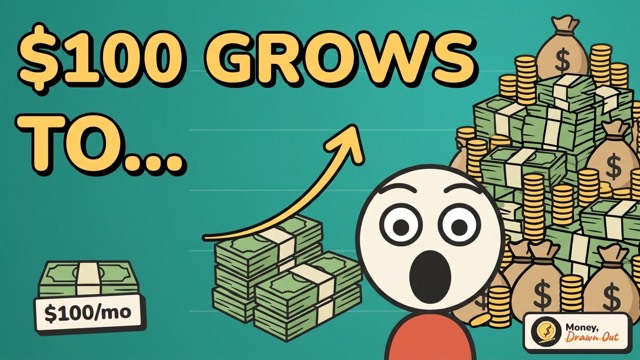
What Happens If You Invest $100 a Month? The Honest Math
You put in $48,000. You could walk away with about $262,000. Here is exactly where the other $214,000 comes from, and why waiting ten years costs more than $140,000.
Lesson 3 · Saving & Banking
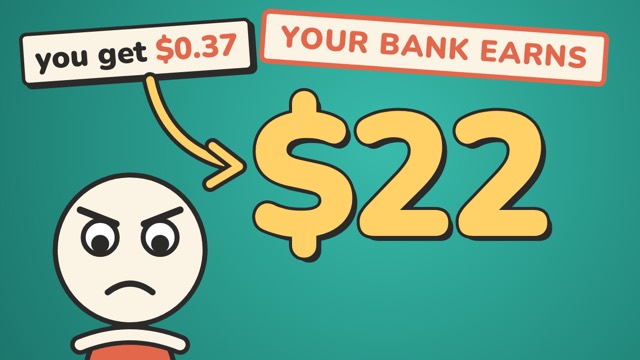
How Banks Make Money: Your Bank Pays You 37¢ and Earns Up to $22 on Your $100
Your $100 isn't sitting in a vault. Here's what your bank actually does with it, how the spread turns 37 cents into up to $22, and how to get on the right side of the deal.