
Lesson 12 · Big Money Decisions · 10 min read
Renting vs Buying a Home: Who Actually Wins? The Honest Math
"Renting is throwing money away." Is it? We follow a buyer and a renter with the same income and savings for 30 years, using today's rates and every real cost, and show the three conditions that actually decide the winner.
Updated
The lesson in 30 seconds
- In month one, Sam the buyer spends about $3,540, but only about $270 builds equity. About $3,270 is gone, vs $2,300 in rent for Alex.
- With a 7.4% mortgage and the renter investing the difference, the renter leads at 3, 10 and 20 years. By 30 years they're almost tied, at about $1.1 million each.
- Condition 1: renting only wins if the renter really invests the difference. Spend it and the buyer wins by about $350,000 at 20 years.
- Condition 2: at a 6% mortgage, buying pulls ahead from about year 8 and leads by about $139,000 at 20 years.
- Condition 3: buying and selling costs about 9% of the price, so buying rewards people who stay. Sellers' median tenure is about 11 years.
Two identical houses on the same street. Sam buys one. Alex rents the other. Sooner or later someone tells Alex the classic line: "Renting is just throwing money away."
Is it, though? Sam is also paying a lot of money every month that never comes back. It just has different names.
In this lesson we follow both of them for thirty years with honest numbers: today's mortgage rates, the real costs of owning, and what happens if Alex actually invests the difference. By the end you'll see that the winner isn't decided by who buys and who rents. It's decided by three conditions most people never check.
The setup: same income, same savings
Sam and Alex have the same income, and each has saved $52,000.
| Sam: buys | Alex: rents | |
|---|---|---|
| Home | $400,000 house | Similar house nearby |
| Upfront | $40,000 down (10%) + $12,000 closing costs | Invests the full $52,000 |
| Monthly housing | $360,000 mortgage, 30-year fixed at 7.4% | $2,300 rent, rising 3% a year |
| The promise | Invest every dollar renting saves, every month |
The $400,000 price is close to the US median existing-home price ($429,100 in August 2026). A 10% down payment is typical for first-time buyers, and 7.4% is roughly where average 30-year rates are this month. $2,300 is close to the typical single-family rent.
Month one: where the money really goes
Sam's mortgage payment (principal and interest) is about $2,490. Look inside it, then add everything else that comes with owning:
| Sam's first month | Amount | Builds equity? |
|---|---|---|
| Mortgage interest | about $2,220 | No |
| Mortgage principal | about $270 | Yes |
| Property tax (about 1% a year) | about $330 | No |
| Homeowners insurance | about $200 | No |
| Maintenance (about 1% a year) | about $330 | No |
| PMI (mortgage insurance, less than 20% down) | about $180 | No |
| Total | about $3,540 |
Of all that, only about $270 becomes Sam's. The other $3,270 or so is gone: interest, taxes, insurance and repairs. Alex pays $2,300 in rent, also gone.
So in month one, the money that never comes back is about $3,270 for Sam and $2,300 for Alex. Rent isn't throwing money away; it's paying for housing. And so is most of a new mortgage payment.
Scoreboard: 3 years
Alex's housing costs about $1,200 a month less than Sam's, so Alex invests that difference every month, plus the original $52,000, at 7% a year, the same honest number from Lesson 9.
After three years, Sam's house is worth about $443,000 if prices grow about 3.5% a year. But selling a house costs money too: agent commissions and closing costs of around 6%. After paying off the loan, Sam would walk away with about $68,000. Alex's investments, after taxes on the gains, are worth about $110,000.
| After 3 years | Wealth |
|---|---|
| Sam (home equity after selling costs) | about $68,000 |
| Alex (portfolio after tax) | about $110,000 |
Alex is ahead by about $40,000. Buying a house and selling soon after is expensive: Sam paid to get in, and would pay again to get out.
Rent rises, the mortgage doesn't
But time works differently for each of them. Sam's principal-and-interest payment is fixed for thirty years. Taxes, insurance and repairs go up, but the biggest piece stays exactly the same.
Alex's rent doesn't stay the same. At 3% a year:
| Year | Alex's monthly rent |
|---|---|
| 1 | $2,300 |
| 3 | about $2,510 |
| 10 | about $3,090 |
| 20 | about $4,150 |
So every year Alex's advantage gets a little smaller, and the monthly difference Alex can invest shrinks. Around year 21 in our example, the lines cross and owning becomes cheaper every month than renting. When the mortgage is paid off at year 30, Sam's housing cost drops to just taxes, insurance and repairs. Alex's rent has no finish line.
Amortization: why early years build wealth slowly
One more thing is quietly changing inside Sam's payment: amortization, which is how almost every mortgage works. The payment stays the same, about $2,490, but what's inside it shifts over time.
| Month | Goes to the loan (principal) | Goes to interest |
|---|---|---|
| 1 | about $270 | about $2,220 |
| 120 (year 10) | about $570 | about $1,930 |
| 240 (year 20) | about $1,190 | about $1,310 |
| 360 (last payment) | about $2,480 | about $15 |
Picture a seesaw: at the start, interest sits heavy on one side, and every month a little more weight moves to Sam's side. That's why the early years of a mortgage build wealth so slowly and the later years so fast, and another reason buying rewards people who stay.
Scoreboard: 10 years
Sam's house is worth about $564,000, and Sam still owes about $312,000. After selling costs, Sam's wealth from the house is about $219,000. Alex's investments, after taxes, are worth about $270,000.
Alex is still ahead, by about $50,000. With mortgage rates this high, renting and investing keeps a real lead for a long time.
But look at what each of them owns. Sam has a home to paint, fix and keep. Alex has a portfolio that's easy to move and easy to sell a piece of. Both are real wealth; they just feel very different.
Scoreboard: 20 and 30 years
| Checkpoint | Sam (buyer, after selling costs) | Alex (renter, after tax) | Leader |
|---|---|---|---|
| 3 years | about $68,000 | about $110,000 | Alex by about $42,000 |
| 5 years | about $106,000 | about $152,000 | Alex by about $45,000 |
| 10 years | about $219,000 | about $270,000 | Alex by about $52,000 |
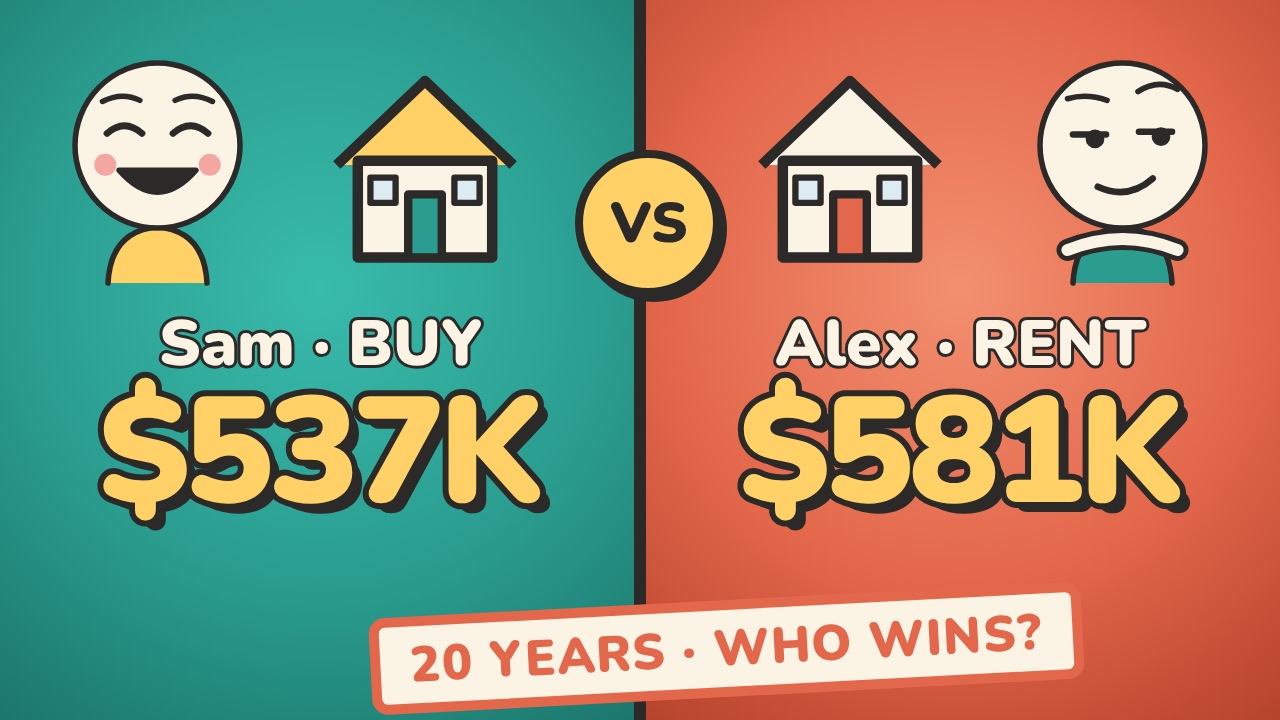
| 20 years | about $537,000 | about $581,000 | Alex by about $44,000 |
| 30 years | about $1,099,000 | about $1,135,000 | Almost tied |
At 20 years Sam's house is worth almost $800,000 with about $211,000 left on the loan, and Alex's rent is now about the same as Sam's monthly cost, and still rising. By year 30 they're almost tied, both around $1.1 million. Sam owns a paid-off house; Alex owns a big portfolio and still pays rent.
So in this example, at today's rates, renting-and-investing and buying come out surprisingly close. That means the real answer comes down to three conditions.
Condition 1: does the renter invest the difference?
Our math assumed Alex invests every spare dollar, every month, for thirty years, in good markets and scary ones. But real life is tempting. That extra $1,200 a month can quietly become a nicer car, more trips and a bigger lifestyle (lifestyle creep).
So run it again: this time Alex invests only the original $52,000 and spends the monthly difference.
| Sam (buyer) | Alex invests everything | Alex spends the difference | |
|---|---|---|---|
| 10 years | about $219,000 | about $270,000 | about $97,000 |
| 20 years | about $537,000 | about $581,000 | about $186,000 |
That's the hidden superpower of a mortgage: forced saving. Sam doesn't decide every month whether to build wealth; the payment decides for Sam. Renting only wins if the renter is disciplined. Be honest with yourself about which one you are.
Condition 2: the mortgage rate (7.4% vs 6%)
Rates change the math more than almost anything else. Keep everything the same, but give Sam a 6% mortgage instead of 7.4%:
- The monthly payment drops by about $335 (to about $2,160).
- Less interest, and more of every payment builds equity.
- The result flips: buying pulls ahead after about 8 years, and after 20 years Sam leads by about $139,000.
Same house, same rent, same people; only the interest rate changed. That's why there's no permanent answer to rent vs buy. It depends on rates in the year you sign. If you buy when rates are high and they fall later, you may be able to refinance, but that costs money too, and nobody can promise rates will drop. Your credit score also affects the rate you're offered.
Condition 3: how long you stay
Buying has a cost on the way in (closing costs) and a cost on the way out (selling costs). Together, in our example, that's around 9% of the home's price. Sell after three years and those costs eat a big part of everything you built, which is why Sam was so far behind at year three.
The longer you stay, the more time you have to spread those costs out, pay down the loan and let the home's value grow. Homeowners who sell today have stayed a median of about 11 years.
So ask yourself honestly: will you still want to live in this city, in this house, in seven, ten or fifteen years? If the answer is "I'm not sure", that's a strong point for renting, for now.
Risks a spreadsheet doesn't show
Neither path is risk-free; they carry different risks.
For the buyer:
- Mobility. If a great job opens up in another city, a renter can give notice and move. An owner has to sell, or become a landlord from far away.
- Concentration. An index fund owns thousands of companies. Sam's wealth is mostly one house on one street in one city.
- Liquidity. If Alex needs $20,000, Alex can sell part of the portfolio. Sam would have to borrow against the house or sell it.
- Surprise repairs. A new roof or furnace can cost thousands at once. Owners need a bigger emergency fund.
For the renter: rent can jump at renewal, the landlord can sell and Alex may have to move, and Alex can't renovate the kitchen.
It doesn't have to be either/or
You don't have to choose forever.
- Some people rent a few more years on purpose: they invest, build a bigger down payment and buy later with 20% down, which removes PMI and lowers the monthly cost.
- Some people buy and keep investing. Owning a home doesn't mean you stop contributing to retirement accounts (Lesson 8).
- Some people rent in an expensive city and invest, because the price-to-rent math there strongly favors renting.
The point isn't to win an argument at a family dinner. It's to know what your choice really costs, and to do the part that makes it work: if you buy, stay long enough; if you rent, invest the difference.
Quick check: the price-to-rent ratio
Here's a quick tool for your own city: the price-to-rent ratio. Divide the price of a home by one year of rent for a similar home.
In our example: $400,000 ÷ ($2,300 × 12 = $27,600) ≈ 14.5.
The higher that number is where you live, the more expensive buying is compared with renting, and the more renting-and-investing tends to win. The lower it is, the more buying makes sense. It's only a shortcut (mortgage rates, property taxes and how long you'll stay still matter), but it tells you in thirty seconds which way your city leans.
3 rent-vs-buy mistakes
1. Comparing rent to the mortgage payment alone. Add property taxes, insurance, maintenance and PMI. That's the real monthly cost of owning.
2. Buying when you might move in a few years. Closing and selling costs can wipe out years of progress.
3. Renting and spending the difference. Then you get neither the house nor the portfolio.
Three things to do this week
- Find the real monthly cost of owning a home you'd actually buy: mortgage, taxes, insurance, maintenance, plus PMI if you'd put less than 20% down.
- Calculate the price-to-rent ratio in your area with a real listing and a real rent.
- If you rent, automate the difference. Set up an automatic investment for the same day rent leaves your account. That's what makes renting work.
Frequently asked questions
Is renting really throwing money away?
No. Rent pays for housing, and so does most of a new mortgage payment. In our example, in the first month only about $270 of a buyer's roughly $3,540 housing cost went toward equity; the rest was interest, property tax, insurance, maintenance and PMI.
Is it better to rent or buy a house?
It depends on three things: whether a renter actually invests the money they save, the mortgage rate, and how long you'll stay. In our 30-year example at a 7.4% rate, renting and investing led for about two decades and the two paths ended almost tied. At a 6% rate, buying pulled ahead after about eight years.
How long should you live in a house to make buying worth it?
Long enough to cover buying and selling costs, which can total around 9% of the home's price. In many scenarios that means at least five to ten years, and the median seller has stayed about 11 years. If you might move sooner, renting is often cheaper.
What is the price-to-rent ratio?
It's the home price divided by a year of rent for a similar home. A $400,000 home that would rent for $2,300 a month has a ratio of about 14.5. Higher ratios tend to favor renting and investing; lower ratios tend to favor buying.
What costs do homeowners pay besides the mortgage?
Property taxes (often around 1% of the home's value a year, but varying widely by location), homeowners insurance, maintenance and repairs (a common estimate is about 1% a year), HOA fees in some communities, and private mortgage insurance (PMI) if you put down less than 20%. Selling a home typically costs around 6% as well.
Does a mortgage help build wealth?
Yes, through principal payments and any rise in the home's value, and it acts as forced saving because the payment happens every month. But early payments are mostly interest, so wealth builds slowly at first and faster later in the loan.
Assumptions and sources
Monthly simulation over 30 years; both start with $52,000, and whoever has the lower monthly housing cost invests the difference at 7% a year. Illustrative $400,000 home (NAR median existing-home price $429,100, August 2026) vs $2,300 a month rent (Zillow typical single-family rent $2,314, July 2026), rising 3% a year. 10% down (NAR 2025 Profile of Home Buyers and Sellers: median first-time-buyer down payment 10%) plus 3% closing costs. 30-year fixed at 7.4% (Freddie Mac PMMS, October 8, 2026); PMI 0.6% a year until 20% equity. Property tax 1% a year, maintenance 1% a year, insurance $2,400 a year rising 3%. Home appreciation 3.5% a year (assumption, slightly below the long-run national average). Selling costs 6%. 15% tax on investment gains at each checkpoint; home sale gain assumed tax-free. Median seller tenure 11 years (NAR). All results are calculated estimates; your city, rate and habits will change the answer. Not financial, tax or real-estate advice.
One new lesson every week
Each lesson builds on the one before. Subscribe on YouTube so you don't miss the next one.
Subscribe on YouTube See all lessonsKeep learning
Lesson 10 · Big Money Decisions
Gas, Hybrid or Electric? What a Car Really Costs Over 5 vs 10 Years
Most comparisons stop at five years, right when a car has lost the most value. We run the honest math for 5 and 10 years, and show why the answer can flip just by keeping the same car longer.
Lesson 11 · Big Money Decisions
Lease, Finance or Pay Cash? The Honest Math of Your Next Car
Same $30,000 car, same day at the dealership: lease it, finance it or pay cash? We follow all three for 3, 6 and 10 years, and the gap at the end is about $30,000.
Lesson 9 · Investing
What Happens If You Invest $10,000 in an Index Fund? The Honest Math
Videos promise that $10,000 in an index fund becomes $700,000. That needs almost 15% a year for 30 years. Here's the honest version, how index funds beat most stock pickers, and the number you can actually plan on.