Enter your debts and interest rates. The debt ladder shows which to pay off first, which are a close call, and which can wait while you invest.
Calculated estimates for education only, not financial advice. Real returns and card terms vary. See how we check the numbers.
How to use this calculator
Add each debt you have: a name, the balance and the interest rate (APR) from your statement. The calculator puts every debt on a rung of the debt ladder, highest rate at the top, and tells you where your next extra dollar should go.
It starts with an example: a $6,000 credit card at 22%, a $15,000 car loan at 7% and a $20,000 student loan at 6.5%, the same debts Sam and Alex have in Lesson 14. Change them to your own numbers, add rows or remove them.
The debt ladder: three zones
| Zone | Interest rate | Typical debts | What to do |
|---|
| 🔴 Red | above about 8% | credit cards, store cards, most personal loans | Pay off first, highest rate first |
| 🟡 Yellow | about 5% to 8% | today's car loans, new student loans, new mortgages | Close call: pay extra, invest, or split |
| 🟢 Green | below about 5% | older low-rate car loans, mortgages and student loans | Pay the minimum and invest the rest |
Why the interest rate decides it
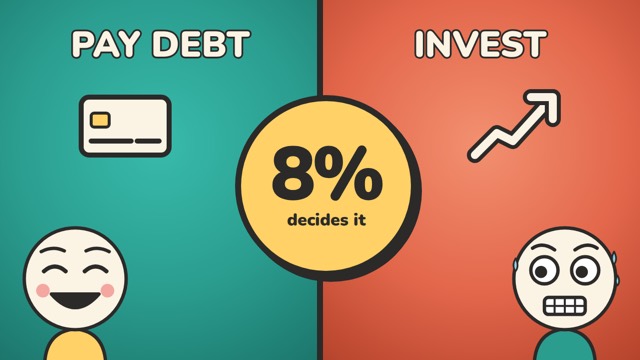
Paying off a debt earns a guaranteed return equal to its interest rate. Investing earns a possible return: the US stock market has averaged roughly 10% a year before inflation, but with big swings (about −37% in 2008).
So the question is always: a guaranteed X% versus a possible 10% with ups and downs. Above about 8%, the guaranteed return wins once you count taxes and risk. Below about 5%, investing usually comes out ahead; even a high-yield savings account pays around 4%. In between, it's genuinely close.
What we found when we tested it
In Lesson 14, we followed two people with the same three debts and the same extra $500 a month for 10 years, in a 5%, a 7% and a 10% market:
- Keeping the 22% credit card lost in every market, even the 10% one.
- For the 7% car loan and the 6.5% student loan, paying them off or investing ended within a few hundred dollars in a 7% market. The winner depended on the market, which nobody can know in advance.
That's exactly what the yellow zone means: either choice is reasonable.
Avalanche vs snowball
The calculator lists your debts in avalanche order (highest rate first), which saves the most interest. If the snowball order (smallest balance first) is different, it shows that too. The snowball costs a little more but gives quicker wins, and the best plan is the one you'll stick with. Lesson 2 explains both.
Before you use the ladder
Two things usually come first:
- Your employer's 401(k) match. A 100% match beats even a 22% card. Get the full match before paying extra on anything.
- A small emergency fund, around $1,000, so the next surprise doesn't go right back on a card.
The full order is in the smartest order to use your money. To see how fast a single card disappears with a bigger payment, use the credit card payoff calculator.
Frequently asked questions
Should I pay off debt or invest?
It mostly depends on the interest rate. A common rule of thumb: pay off debt above about 8% before investing beyond an employer match, pay the minimum and invest when the rate is below about 5%, and treat 5% to 8% as a close call where splitting your extra money is reasonable.
Which debt should I pay off first?
Mathematically, the one with the highest interest rate (the avalanche method). If you need motivation, paying the smallest balance first (the snowball method) also works, at a slightly higher cost. Always keep paying at least the minimum on every debt.
Is it better to pay off a car loan or invest?
At today's typical rates of around 7%, it's a close call. Paying it off early is a solid, guaranteed return; investing might do a bit better or a bit worse. Many people split their extra money between the two.
Should I invest if I have student loans?
Usually yes, after your employer match, if the rate is low. Student loans below about 5% are in the green zone; new federal loans around 6.5% are a close call; private loans above 8% are usually worth paying off first.
Does this calculator store my debts?
No. Everything is calculated in your browser, and nothing you type is sent to us or saved.