
Lesson 14 · Credit & Debt · 12 min read
Pay Off Debt or Invest? The Honest Math (The Interest Rate That Decides It)
Same three debts, same $500 extra a month. One pays off everything first, one invests from day one. We follow both for 10 years in three different markets and turn the result into one simple rule.
Updated
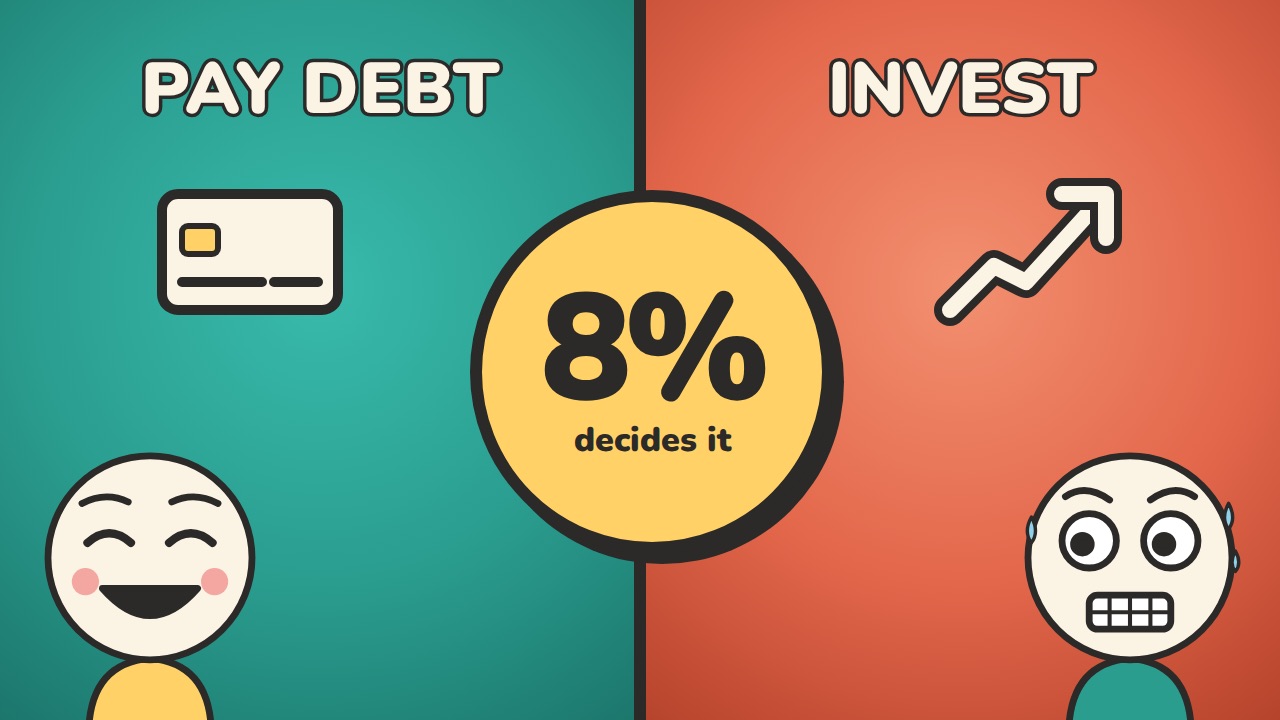
The lesson in 30 seconds
- Paying off a debt earns a guaranteed return equal to its interest rate. Investing earns a possible return of about 10% a year, with ups and downs.
- In our 10-year test at 7%, paying off all debt first ended at about $124,000; investing from day one, about $117,000. Total interest: about $5,100 vs $17,600.
- Keeping the 22% credit card lost in every market we tested, even a 10% one.
- The rate ladder: above about 8%, pay it off first; below about 5%, pay the minimum and invest; 5% to 8% is a close call, and splitting is fine.
- Before the ladder: get the full employer match and build a small emergency fund.
Sam and Alex have the same three debts: a credit card, a car loan and a student loan. Every month, after the bills, both have $500 left over.
Sam throws every extra dollar at the debts. Alex invests every extra dollar and pays only the minimums. Ten years later one of them is clearly ahead, and when we test it in a bad market, an average market and a great market, the answer isn't what either of them expected.
In this lesson we run the honest math on paying off debt vs investing, and by the end you'll have one simple rule based on a single number you can find on your statement in ten seconds: the interest rate.
The setup: same debts, same budget
Sam and Alex already have a small emergency fund, and both already get their full employer 401(k) match. (We'll come back to why that matters.) Each has the same three debts, at rates beginners actually face in 2026:
| Debt | Balance | Interest rate | Term | Minimum payment |
|---|---|---|---|---|
| Credit card | $6,000 | 22% | revolving | about $170 to start |
| Car loan | $15,000 | 7% | 5 years | about $297 |
| Student loan | $20,000 | 6.5% | 10 years | about $227 |
| Total | $41,000 | about $694 |
The 22% card is right around the US average for cards that charge interest. The car loan is close to today's average new-car rate, and 6.5% is the rate on new federal undergraduate loans for the 2026–27 school year.
On top of the minimums, each has $500 extra, so both spend the same total, about $1,194 a month, for ten years. The only difference is where the extra $500 goes.
Paying off debt is a guaranteed return
One idea makes this whole lesson click: when you pay off a debt, you earn a return, a guaranteed one, equal to the interest rate.
Pay off a card that charges 22%, and every dollar you send stops costing you 22 cents a year. That's the same as earning 22%, with zero risk. Pay off a 7% loan and you've earned 7%, guaranteed.
Investing works differently. The US stock market has averaged roughly 10% a year over the long run, before inflation. But that's an average, not a promise: some years it's up 30%, and in 2008 it fell about 37%.
So the real question is never "debt or investing?". It's this: a guaranteed return of X% versus a possible return of about 10%, with ups and downs along the way.
The two paths
Sam: the avalanche. Sam goes after the debts, highest interest rate first. All the extra money goes to the credit card; when the card is gone, everything goes to the car loan, then the student loan. Only when every debt is paid does Sam start investing, with the whole $1,194 a month.
Alex: invest from day one. Minimum payments on everything, and the extra $500 goes straight into an index fund every month. Whenever a loan ends, its payment joins the investing too.
For now, the market grows 7% a year. We'll test 5% and 10% later. (Investments are assumed to be in a tax-advantaged account such as a Roth IRA; see Lesson 13.)
The 22% credit card
The first big difference is the credit card.
| The $6,000 card at 22% | Sam (extra $500 to the card) | Alex (minimum payments only) |
|---|---|---|
| Paid off | in 10 months | still about $1,700 owed after 10 years |
| Interest paid | about $615 | about $7,500 so far |
Remember the minimum payment trap from Lesson 2: the minimum shrinks as the balance shrinks, so the card barely moves. Same card, same balance. One of them paid about $600 in interest; the other paid more than twelve times as much and still isn't done.
Scoreboard: 3 years
| After 3 years (7% market) | Sam | Alex |
|---|---|---|
| Invested | $0 | about $20,900 |
| Debt still owed | about $3,100 | about $26,000 |
| Net worth from this plan | about −$3,100 | about −$5,100 |
Alex's investment account looks much bigger, but Alex still owes about $26,000. Sam is actually ahead. A few months later Sam makes the last payment: debt-free in 3 years and 3 months.
Scoreboard: 5 and 10 years
Now Sam has nearly $1,200 a month to invest, every month, with no debt payments left.
| 7% market | Sam (debt first) | Alex (invest first) |
|---|---|---|
| Net worth at 5 years | about $27,100 (no debt) | about $23,800 ($38,600 invested, $14,800 owed) |
| Net worth at 10 years | about $123,900 | about $117,200 |
| Total interest paid over 10 years | about $5,100 | about $17,600 |
Sam wins by about $7,000, and paid about $12,500 less in interest along the way.
The middle path: card first, then invest
Is that the whole story? Most of Sam's win came from one debt, the credit card. What about the other two?
So we add a third path, the middle path: kill the credit card first, exactly like Sam, then invest the extra money and pay only the minimums on the car and student loans.
| 7% market, after 10 years | Net worth | Total interest |
|---|---|---|
| Sam (all debt first) | about $123,900 | about $5,100 |
| Middle path (card first, then invest) | about $124,400 | about $10,700 |
| Alex (invest from day one) | about $117,200 | about $17,600 |
Sam and the middle path finish within a few hundred dollars of each other. That's the real lesson hiding in this example: the 22% card was a disaster to keep, but for the 7% car loan and the 6.5% student loan, it barely mattered which way you went.
Stress test: 5%, 7% and 10% markets
Seven percent is just one possible future, so let's run all three paths through a weak, an average and a strong market:
| Net worth after 10 years | 5% market | 7% market | 10% market |
|---|---|---|---|
| Sam (all debt first) | about $115,400 | about $123,900 | about $138,200 |
| Middle path (card first) | about $113,600 | about $124,400 | about $143,100 |
| Alex (invest first) | about $106,500 | about $117,200 | about $136,300 |
Notice two things:
- Alex, who kept the credit card, never wins. Not even in a great market. Investing while carrying a 22% card lost in every future we tested.
- For the medium-rate loans, the winner depends on the market, which nobody can know in advance. In a weak market, paying everything off wins; in a strong market, investing after the card wins.
The rate ladder: one rule for every debt
Here's the rule, drawn as a ladder. Find the interest rate on each of your debts and put it on a rung.
| Zone | Interest rate | Typical debts | What to do |
|---|---|---|---|
| 🔴 Red | above about 8% | credit cards (~22%), store cards, personal loans (avg ~12.5%) | Pay off first, as fast as you can |
| 🟡 Yellow | about 5% to 8% | today's car loans, new student loans, new mortgages | Close call: pay extra, invest, or split |
| 🟢 Green | below about 5% | an old 3% car loan, a 2021 mortgage, older student loans | Pay the minimum and invest the rest |
Red zone: no investment reliably beats a guaranteed return that high. Green zone: even a high-yield savings account earns about 4%, so this debt is cheap. Yellow zone: paying it off is a solid, guaranteed return; investing might do a bit better or a bit worse. Splitting the extra money is a perfectly good answer.
Why 8% and 5%?
They aren't magic numbers. Here's the thinking:
- You don't keep the full 10%. In a regular taxable account you pay tax on gains, and many investors earn less than the market average by buying high and selling low.
- 10% is a maybe; the debt rate is a sure thing. A guaranteed 8% is worth more than a possible 10%.
Two warnings:
- Compare like with like. Some comparisons put your 7% loan next to a 7% return "after inflation". That's apples to oranges: your loan rate includes inflation, so compare it with a return that includes inflation too (about 10%, not 7%).
- Tax deductions rarely change the answer. Most people now take the standard deduction ($16,100 for single filers in 2026), so mortgage interest saves them nothing on taxes. Student loan interest can be deducted, but only up to $2,500 a year and only below certain income limits.
Inflation and fixed-rate debt
One more force quietly works on every fixed-rate loan: inflation.
A $300 car payment stays $300 for five years, while prices around it rise about 3% a year. Because paychecks usually rise with prices, that same payment gets a little easier to afford each year. That's why people say fixed-rate debt "gets cheaper over time".
It's true, but only partly. It helps most with long, low-rate loans, like a 30-year mortgage at 3%. It does nothing to rescue a credit card: at 22%, 3% inflation is a tiny discount on a huge price. The ladder still wins.
What comes before the ladder
The ladder is a great rule, but a few things come before it, or bend it:
- The employer match. If your job matches 401(k) contributions, get the full match before paying extra on anything, even the credit card. A 100% return on day one beats 22%. That's step 2 of the smartest order to use your money.
- A small emergency fund. Send every spare dollar to debt with no cushion, and the next car repair goes right back on the card. A small buffer first, then the attack (Lesson 5).
- Cash flow. A paid-off loan frees its whole payment every month. Sam ended up with almost $1,200 a month free, flexibility you really feel if you lose your job.
- Liquidity. Money sent to a loan is gone. Money invested can come back out if you truly need it. That's one reason not to rush a low-rate loan.
Avalanche vs snowball
If you decide to attack debt, which one goes first?
- Avalanche: highest interest rate first. It saves the most money; that's what Sam did.
- Snowball: smallest balance first, regardless of rate. It costs a bit more, but quick wins keep some people going.
In our example they're the same, because the credit card was both the smallest balance and the highest rate. In real life they often differ. The honest answer: the avalanche wins on paper; the snowball wins if it's the only plan you'll actually stick to. The worst plan is the one you quit.
What a spreadsheet can't measure
Some people sleep better with zero debt. If paying off a 6.5% loan early gives you peace of mind, that isn't a mistake: you're trading a possible extra return for a guaranteed one plus calm. Other people are fine carrying a cheap loan for years while their investments grow. That isn't a mistake either.
What does hurt is switching back and forth: investing when markets are up, then panicking and paying debt when they're down. Pick your rule, write it down and let it run.
The ladder on a real list
Let's put the ladder to work on a realistic list of four debts:
| Debt | Rate | Zone | Plan |
|---|---|---|---|
| Store card | 29% | 🔴 Red | First: every extra dollar |
| Personal loan | 12% | 🔴 Red | Second, once the store card is gone |
| Car loan | 7% | 🟡 Yellow | Minimum for now; later extra payments, investing or both |
| Student loan (from a few years ago) | 4% | 🟢 Green | Minimum payment; invest the rest |
Notice what you didn't need: no stock market prediction, no gut feeling, no argument with your brother-in-law. Just the rate on each statement and the rung it lands on.
The order, from your paycheck down
Here's the full order, Lesson 8 with the debt part zoomed in:
- A small emergency fund (about $1,000).
- The full employer match.
- Every debt in the red zone (above 8%), highest rate first.
- A full emergency fund, 3 to 6 months of essential expenses.
- Retirement accounts, such as the Roth IRA.
- The yellow zone (5% to 8%): pay extra, invest, or split it. Your call.
And the green zone, below 5%? Pay the minimum and let it be.
3 common mistakes
1. Investing while carrying a credit card balance. In our example it lost in every market we tested.
2. Paying off cheap debt while skipping the employer match. You trade a 100% return for 3% or 4%.
3. Sending every dollar to debt with no emergency fund. The first surprise bill lands right back on the card.
Three things to do this week
- List every debt with three numbers: the balance, the minimum payment and the interest rate.
- Put each one on the ladder: red, yellow or green.
- Automate an extra payment to your highest red-zone rate, starting this month, even $50. Every dollar there earns a guaranteed return you won't find anywhere else.
Frequently asked questions
Should I pay off debt or invest?
It depends mostly on the interest rate. Paying off a debt earns a guaranteed return equal to its rate, while investing earns a possible return of roughly 10% a year before inflation, with ups and downs. A common rule of thumb: pay off debt above about 8% first, pay the minimum and invest when the rate is below about 5%, and treat 5% to 8% as a close call where splitting is reasonable.
Should I invest while I have credit card debt?
Generally no, beyond getting any employer 401(k) match. At around 22% APR, paying off a credit card beats any realistic investment return. In our 10-year test, the path that kept the card and invested lost in a 5%, a 7% and even a 10% market.
Should I pay off my car loan early or invest?
At today's typical rates of around 7%, it's a close call. In our example, paying off a 7% car loan early and investing after the credit card ended within a few hundred dollars of each other in a 7% market. Paying it off wins in weaker markets; investing wins in stronger ones. Splitting the extra money is a sensible choice.
Should I pay off student loans or invest?
For student loans around 6% to 7%, it's a close call; for older loans below 5%, investing usually makes more sense; for private loans above 8%, paying them off first is usually better. Get your employer match and build an emergency fund first, and remember that the student loan interest deduction is limited to $2,500 a year and phases out at higher incomes.
What is the 8% rule for debt?
It's a rule of thumb, not a law: debts with interest rates above about 8% (credit cards, store cards, most personal loans) should usually be paid off before investing beyond an employer match, because a guaranteed 8% or more is hard to beat after taxes and market risk. Below about 5%, investing tends to win; in between, either choice is reasonable.
Is the avalanche or snowball method better?
The avalanche (highest interest rate first) saves the most money. The snowball (smallest balance first) costs a little more but gives quick wins that help some people stay motivated. The best method is the one you'll stick with until the debt is gone.
Assumptions and sources
Monthly simulation over 10 years. Every path uses the same budget: the starting minimum payments ($170.00 card + $297.02 car + $227.10 student loan = $694.12) plus $500 extra, or $1,194.12 a month. Card minimum = interest + 1% of the balance (minimum $25), recalculated monthly; car and student loan payments are fixed. Money freed up by paid-off debts is invested monthly. Investments are assumed to be in a tax-advantaged account; in a taxable account, paying off debt looks slightly better. Net worth = investments minus remaining debt. Credit card APR 22% (Federal Reserve G.19: 22.36% on accounts assessed interest, August 2026). Car loan 7.0% over 60 months (Edmunds Q3 2026 average new-car APR). Student loan 6.5% over 10 years (federal Direct undergraduate loans 6.52% for 2026–27). Personal loans average 12.55% (Bankrate, October 2026). Market returns of 5%, 7% and 10% a year are assumptions; real returns vary (S&P 500 2008: −37%). Student loan interest deduction up to $2,500 a year with income limits; 2026 standard deduction $16,100 for single filers (IRS). The rate ladder is a rule of thumb, not personal advice. All results are calculated estimates; your numbers will differ. Sam and Alex are illustrative examples.
One new lesson every week
Each lesson builds on the one before. Subscribe on YouTube so you don't miss the next one.
Subscribe on YouTube See all lessonsKeep learning
Lesson 2 · Credit & Debt
The Credit Card Minimum Payment Trap: How $2,000 Becomes $4,600
Pay only the minimum on a $2,000 card and it takes almost 12 years and about $2,600 in interest to clear. Here is where every payment really goes, and three ways to escape.
Lesson 4 · Credit & Debt
Your Credit Score, Explained: How It Works and How to Build One From Zero
A three-digit number helps decide your apartment, your car loan and your mortgage rate. Here's what goes into it, what drags it down, and how to build good credit from zero.
Lesson 11 · Big Money Decisions
Lease, Finance or Pay Cash? The Honest Math of Your Next Car
Same $30,000 car, same day at the dealership: lease it, finance it or pay cash? We follow all three for 3, 6 and 10 years, and the gap at the end is about $30,000.