
Guide · Credit & Debt · 7 min read
How Credit Card Companies Make Money (and Who Really Pays for Your Rewards)
Interest, swipe fees, late fees and more: here's exactly where card companies' money comes from, who ends up paying for your rewards, and how to use a card without paying a cent.
Updated
The short answer
- Card companies make most of their money from interest: US cardholders paid about $105 billion in interest and $25 billion in fees in 2022 (CFPB).
- Every time you tap a card, the store pays a swipe fee, about 2.4% on Visa and Mastercard credit cards, most of which goes to the bank that issued your card.
- People who carry a balance paid 94% of all interest and fees but earned only 27% of the rewards.
- Pay your full statement balance on time every month and the card costs you nothing; the people paying interest fund the system.
Watch: Lesson 2, The Credit Card Minimum Payment Trap: How $2,000 Becomes $4,600
Watch the full lesson (10:10) or read the illustrated write-up below. Open on YouTube
Video chapters
- 0:00 $2,000 that costs $4,600
- 0:34 Intro
- 0:42 Sam's $2,000 car repair
- 1:15 How credit cards really work
- 1:51 What 22% APR really means
- 2:52 Where your minimum payment goes
- 3:21 The trap: 11.6 years of payments
- 4:16 Why the minimum exists
- 4:52 The psychology: anchoring
- 5:44 Escape #1: pay a fixed amount
- 6:15 How bigger payments change everything
- 6:51 Escape #2: stop adding to the balance
- 7:13 Escape #3: avalanche, snowball, balance transfers
- 7:54 Paying off debt = a guaranteed return
- 8:59 3 things to do this week
- 9:25 Recap & next lesson
You can sign up for a credit card for free, get cash back on every purchase and pay no interest at all. So how does the bank make money?
The short answer: from the people who don't pay their balance in full, and from the stores where you shop. In 2022, US credit card companies charged consumers about $130 billion in interest and fees, according to the Consumer Financial Protection Bureau (CFPB). On top of that, merchants paid well over $100 billion a year in card swipe fees.
This guide draws out the five main ways card companies make money, who actually pays for your rewards, and how to be the customer the bank earns the least from.
1. Interest: the biggest money-maker
When you don't pay your full statement balance, the remaining amount starts charging interest, shown on your statement as the APR (annual percentage rate). In the US, the average APR on cards that charge interest is about 22% (Federal Reserve, 2026).
That's where most of the money comes from. Of the roughly $130 billion cardholders paid in 2022, about $105 billion was interest.
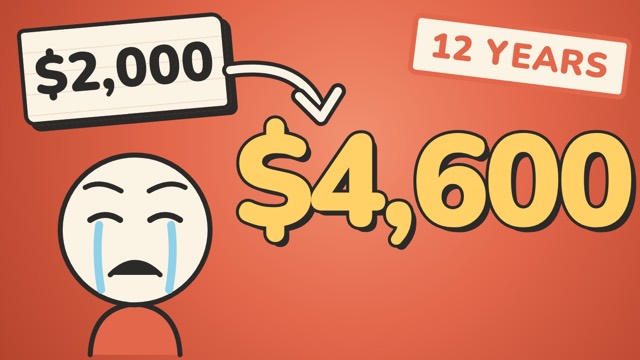
Here's what that looks like for one person. In Lesson 2, Sam puts a $2,000 car repair on a card at 22% and pays only the minimum:
| Paying only the minimum on $2,000 at 22% | |
|---|---|
| Time to pay it off | about 11.6 years |
| Interest paid | about $2,600 |
| Total paid for a $2,000 repair | about $4,600 |
The minimum payment is designed to keep the account in good standing, not to get you out of debt fast. Most of each early payment is interest, and the balance barely moves. You can try your own numbers in our credit card payoff calculator.
2. Swipe fees (interchange): the money you never see
Every time you tap or swipe a credit card, the store doesn't receive the full price. It pays a fee, called interchange or a swipe fee, typically around 1.5% to 3.5% of the purchase depending on the card and the merchant.
For Visa and Mastercard credit cards, the average was about 2.36% in 2025, and merchants paid about $118.8 billion in those fees, according to Nilson Report data cited by the Merchants Payments Coalition. Most of the interchange goes to the bank that issued your card; the card network (Visa, Mastercard) takes a smaller network fee, and the store's payment processor adds its own markup.
On a $100 grocery bill, that's roughly $2.36 the store pays for your card. The store doesn't absorb that out of kindness: swipe fees are built into the prices everyone pays, including people paying with cash.
3. Fees: late, annual, cash advance and more
Fees brought in about $25 billion in 2022. The main ones:
| Fee | Typical cost | How to avoid it |
|---|---|---|
| Late fee | about $30 to $32 on average, up to around $41 | Set up autopay for at least the minimum |
| Annual fee | $0 on basic cards, $95 to $695 on premium rewards cards | Choose a no-annual-fee card unless the perks clearly beat the fee |
| Cash advance fee | often 3% to 5%, plus a higher APR charged from day one | Don't use a credit card at an ATM |
| Balance transfer fee | usually 3% to 5% of the amount moved | Only worth it with a real plan to pay off before the 0% period ends |
| Foreign transaction fee | often about 3% of purchases abroad | Use a card with no foreign transaction fee when you travel |
Late fees alone cost cardholders about $14.5 billion in 2022, according to the CFPB. A federal rule that would have capped most late fees at $8 was struck down by a court in April 2025, so the higher fees remain.
Paying late can also trigger a penalty APR, a higher interest rate that can apply to your balance, and a late payment reported to the credit bureaus can hurt your score for years. Lesson 4 explains how.
4. Other income: partnerships and the rest
Card issuers also earn from:
- Co-branded cards: airlines, hotels and retailers pay banks (and buy points from them) to run cards with their logo, because cardholders become loyal customers.
- Network incentives: Visa and Mastercard pay large issuers incentives to put their logo on the cards.
- Data and offers: card-linked deals ("get $10 back at this store") are paid for by the merchants.
These are smaller than interest and swipe fees, but they help explain why banks compete so hard to get a card into your wallet.
Who really pays for your rewards?
Cash back and travel points aren't free money from the bank. They're funded mainly by two groups:
- Stores (and everyone's prices), through swipe fees.
- Cardholders who carry a balance, through interest and fees.
The CFPB found that consumers who carried debt from month to month paid 94% of all interest and fees but earned only 27% of the rewards at major card companies. In other words, people who pay in full collect most of the rewards, and people who revolve a balance pay for most of them.
| People who pay in full | People who carry a balance | |
|---|---|---|
| Interest paid | $0 | almost all of it |
| Share of rewards earned | most | about 27% |
| What the card really costs | nothing, if there's no annual fee | often hundreds or thousands a year |
That's why "always use a card for the points" is good advice only if you pay the full statement balance every month. A 2% cash back card is a terrible deal next to a 22% APR.
How to use a credit card without paying a cent
Card companies make the least money from one kind of customer: the one who pays in full, on time, every month. Here's how to be that customer:
- Pay the full statement balance by the due date. Thanks to the grace period, most cards then charge zero interest on purchases.
- Turn on autopay for at least the minimum, so you never pay a late fee or get a penalty APR.
- Pick a card with no annual fee unless you'll clearly use the perks.
- Never take a cash advance, and avoid balance transfers without a payoff plan.
- If you already carry a balance, attack it first. Paying off a 22% card is a guaranteed 22% return, better than any investment. Our pay off debt or invest calculator shows which debt to pay first.
Used this way, a credit card is a free short-term loan with fraud protection, and the people paying interest are footing the bill for your rewards.
Frequently asked questions
How do credit card companies make money if you pay in full?
Mainly from swipe (interchange) fees that stores pay on every purchase, about 2.4% on average for Visa and Mastercard credit cards, plus any annual fee. If you pay your full balance on time and have a no-annual-fee card, the bank earns only the swipe fees on your purchases.
What is the biggest source of income for credit card companies?
Interest. According to the CFPB, US cardholders paid about $105 billion in interest and $25 billion in fees in 2022. Swipe fees paid by merchants are the second big source.
Do credit card companies want you to pay in full?
They're happy to have you as a customer, because they still earn swipe fees on your spending. But the most profitable customers are those who carry a balance and pay interest. The CFPB found that cardholders who revolve debt paid 94% of all interest and fees.
Who pays for credit card rewards?
Mostly merchants, through swipe fees that are built into prices for everyone, and cardholders who carry a balance, through interest and fees. People who pay in full earn most of the rewards without paying interest.
How much does a store pay when I use a credit card?
Typically 1.5% to 3.5% of the purchase, depending on the card and the merchant. For Visa and Mastercard credit cards, the average was about 2.36% in 2025. Rewards and premium cards usually carry higher fees.
Sources
Consumer Financial Protection Bureau, Consumer Credit Card Market Report (2023), covering 2022: about $130 billion in interest and fees (about $105 billion interest, $25 billion fees), $14.5 billion in late fees, and consumers who carried debt paying 94% of interest and fees while earning 27% of rewards. Average credit card APR on accounts assessed interest about 22% (Federal Reserve G.19, 2026). Visa and Mastercard credit card swipe fees of $118.8 billion and an average rate of 2.36% in 2025 (Nilson Report data cited by the Merchants Payments Coalition; industry estimates, not official statistics). Average late fee about $32 at major issuers in 2022 (CFPB); the CFPB's $8 late fee rule was vacated by a federal court in April 2025. Fee ranges for annual, cash advance, balance transfer and foreign transaction fees are typical published card terms and vary by card. The $2,000 example comes from Lesson 2 (22% APR, minimum of interest plus 1% of the balance, $25 floor).
Money, explained one sketch at a time
Every guide comes from a full video lesson. Subscribe on YouTube so you don't miss the next one.
Subscribe on YouTube See all lessonsThe full lessons
Lesson 2 · Credit & Debt
The Credit Card Minimum Payment Trap: How $2,000 Becomes $4,600
Pay only the minimum on a $2,000 card and it takes almost 12 years and about $2,600 in interest to clear. Here is where every payment really goes, and three ways to escape.
Lesson 3 · Saving & Banking
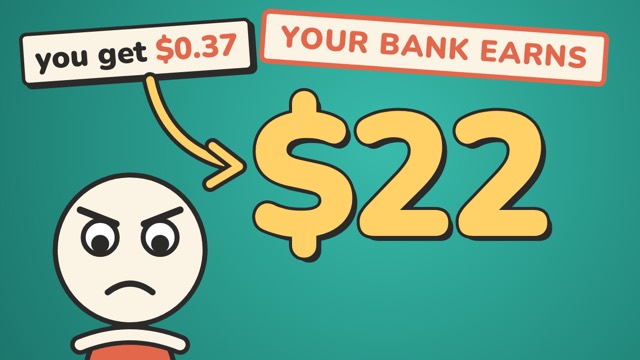
How Banks Make Money: Your Bank Pays You 37¢ and Earns Up to $22 on Your $100
Your $100 isn't sitting in a vault. Here's what your bank actually does with it, how the spread turns 37 cents into up to $22, and how to get on the right side of the deal.