
Lesson 13 · Investing · 13 min read
401(k) vs Roth IRA: Why It's a Perfect Tie (Until It Isn't)
Sam's 401(k) statement says $887,000 and Alex's Roth says $781,000. After tax, they keep exactly the same amount. Here's why, the four things that break the tie, and which account to fill first.
Updated
The lesson in 30 seconds
- "401(k) vs Roth" is really two questions: which account (workplace 401(k) or your own IRA) and when you pay tax (traditional = later, Roth = now).
- In a fair test with the same take-home cost and the same tax rate, traditional and Roth end up exactly tied: taxed-then-grown equals grown-then-taxed.
- Tie-breaker 1: your tax rate now vs later. In the 10% or 12% bracket, Roth often has the edge.
- Tie-breaker 2: the employer match beats everything, and you get it with either a traditional or a Roth 401(k).
- Tie-breakers 3 and 4: Roth shelters more after-tax money per dollar of limit, and Roth IRA contributions can be withdrawn anytime tax- and penalty-free. Common order: match first, Roth IRA second, then back to the 401(k).
Sam and Alex are both 30. Same job, same salary, and they start saving for retirement on the same day. Sam picks a 401(k). Alex picks a Roth.
Thirty-five years later, one of them has a bigger balance, close to $900,000, and you'd think that's the winner. But part of that money was never really Sam's, and when we count what each of them actually gets to keep, the answer surprises almost everyone.
In this lesson we run a fair test with honest numbers. By the end you'll know which account to fill first, and why the real question isn't "401(k) vs Roth" at all.
It's really two questions (the 2×2 grid)
"401(k) vs Roth IRA" sounds like one choice. It's actually two different questions:
- Which account? A 401(k) is a retirement account you get through your job. An IRA is one you open yourself at any brokerage.
- When do you pay the tax? Traditional means you skip the tax today and pay it when you take the money out. Roth means you pay the tax today, and later the money comes out tax-free.
Put those together and you get four boxes:
| Traditional (tax later) | Roth (tax now) | |
|---|---|---|
| 401(k) (through work) | Traditional 401(k) | Roth 401(k) |
| IRA (on your own) | Traditional IRA | Roth IRA |
So a Roth isn't the opposite of a 401(k). In fact, about 96% of 401(k) plans now offer a Roth option inside the plan. Many people have it and never notice.
Tax the seed, or tax the harvest?
Here's an easy way to picture the difference: a seed and the tree it grows into.
- With traditional, you plant the seed tax-free. But when you harvest decades later, the government takes its share of the whole harvest: the seed and all the growth.
- With Roth, you pay tax on the seed. Then the tree grows, and the whole harvest is yours, with no tax on the growth as long as you follow the rules.
Tax the seed, or tax the harvest: that's the entire difference. Most people's instinct says "obviously, tax the small seed, not the big harvest". Let's see if the math agrees.
The fair test: same take-home cost
Sam and Alex each earn $60,000 a year and are single, which puts them in the 12% bracket.
- Sam puts $6,000 a year (10% of salary) into a traditional 401(k). Because it goes in before tax, Sam's tax bill drops by about $720, so Sam's take-home pay only goes down by $5,280.
- Alex wants a fair fight, so Alex gives up exactly the same $5,280 of take-home pay and puts it into a Roth. That money was already taxed, so it goes in as it is.
Same sacrifice from the paycheck, same investments growing 7% a year on average, no employer match yet (we'll add it soon), and the same 12% tax rate today and in retirement. Sam's jar starts bigger: $6,000 vs $5,280.
Scoreboard: 10, 20 and 35 years
| Years | Sam's traditional balance | Alex's Roth balance |
|---|---|---|
| 5 | about $36,900 | about $32,500 |
| 10 | about $88,700 | about $78,100 |
| 20 | about $263,200 | about $231,600 |
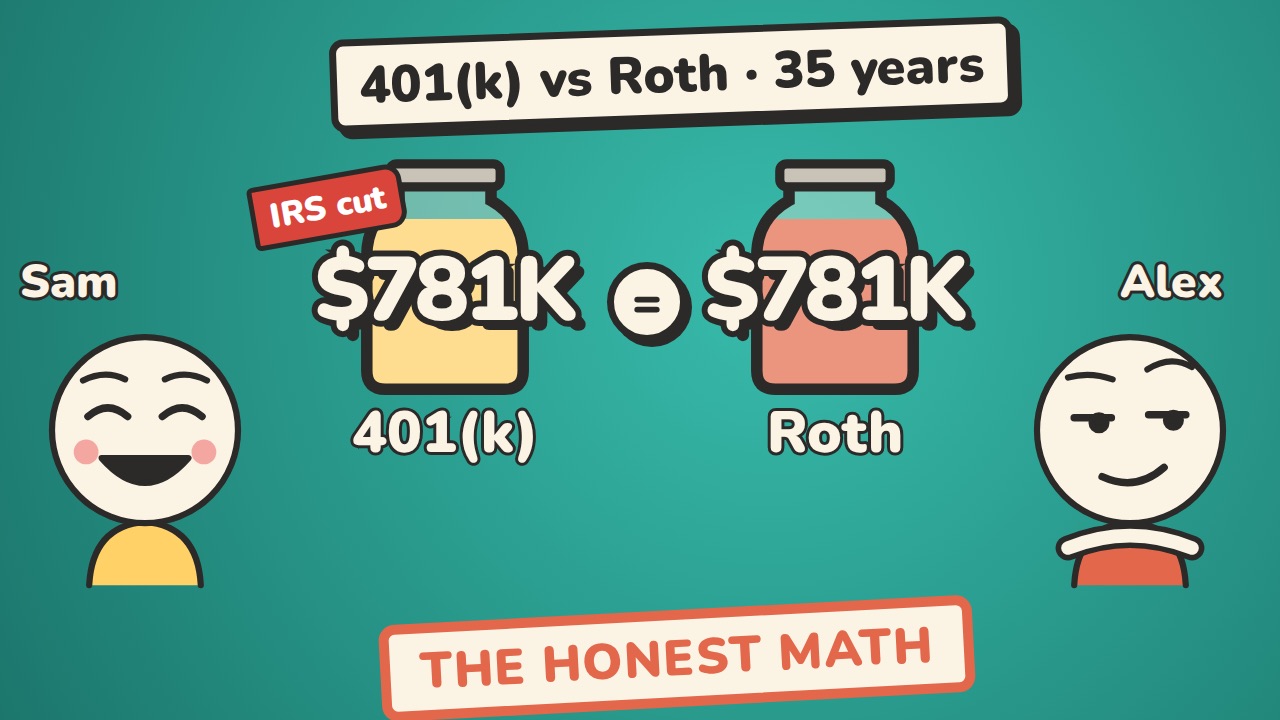
| 35 (age 65) | about $887,500 | about $781,000 |
On every statement, every year, Sam is ahead. Sam looks like the winner.
But Sam's jar has a tag on it: that money hasn't been taxed yet. When Sam takes it out, 12% goes to the IRS. That's about $106,500 that was never really Sam's.
| At 65 | Sam (traditional) | Alex (Roth) |
|---|---|---|
| Balance on the statement | about $887,500 | about $781,000 |
| Tax due on withdrawal (12%) | about $106,500 | $0 |
| What they keep | about $781,000 | about $781,000 |
Exactly the same as Alex. Not close: the same, down to the dollar.
Why it's a perfect tie
Why? Because of a rule you learned in school: when you multiply, the order doesn't matter.
Sam's money gets the growth first and the tax at the end. Alex's money gets the tax first and the growth after. Taxed then grown, or grown then taxed: the same numbers multiplied in a different order give the same answer.
So the seed-and-harvest instinct was wrong. Taxing the small seed isn't automatically better; at the same rate, it doesn't matter at all. This is the honest math most comparisons skip: on its own, neither account makes your money grow faster. Only something that breaks the tie can make one win, and four things do: the tax rate, the match, the limits and flexibility.
Tie-breaker 1: your tax rate now vs later
The most important tie-breaker is your tax rate now compared with your tax rate later. Picture a seesaw: on one side the rate you'd save today, on the other the rate you'd pay in retirement.
| Rate today | Rate in retirement | Winner | By about (in our example) |
|---|---|---|---|
| 12% | 12% | Tie | $0 |
| 12% | 22% | Roth | $89,000 |
| 22% | 12% | Traditional | $89,000 |
If your rate later is higher, Roth wins. If it's lower, traditional wins. So the real question was never "which account is better?" It's this: is my tax rate today higher or lower than it will be when I take the money out?
Your tax bracket today (2026)
For most beginners, today's rate is lower than they think. US income tax comes in layers called brackets. For a single filer in 2026:
| Layer of taxable income (single, 2026) | Rate |
|---|---|
| First $16,100 of income (standard deduction) | 0% |
| Up to $12,400 of taxable income | 10% |
| $12,400 to $50,400 | 12% |
| $50,400 to $105,700 | 22% |
| $105,700 to $201,775 | 24% |
With only the standard deduction, a salary has to pass about $66,500 before any of it reaches the 22% bracket. So Sam and Alex, at $60,000, are in the 12% bracket, along with a big share of people early in their careers.
That matters. Early in your career you're often in one of the lowest brackets you'll ever be in, and your income will probably grow. A Roth lets you pay tax on the seed while the tax is cheap. That's why, for many beginners, Roth gets the edge: not because Roth is magic, but because 12% is a good price.
Your rate later and the Social Security catch
Your rate in retirement is harder to predict, and honestly nobody knows it. It depends on three things.
1. How much you take out. Say that in retirement (in today's money) Sam withdraws $35,000 a year plus receives $24,000 from Social Security.
2. Deductions. Part of Sam's withdrawals land in the tax-free and 10% layers. Under today's rules, Sam's federal tax comes to about $3,600 a year, about 10% of the withdrawals. So far, that's slightly better than the 12% Sam saved.
3. The Social Security catch. When your other income passes certain thresholds, up to 85% of your Social Security becomes taxable. Withdrawals from a traditional account count toward those thresholds; Roth withdrawals don't. And the thresholds haven't been raised for inflation since the 1980s and 1990s, so every year more retirees cross them. In Sam's case, each extra dollar withdrawn is effectively taxed at about 22%, even though Sam is in the 12% bracket. Planners sometimes call this the "tax torpedo".
The honest takeaway: in our example it's close to a tie again, and that's normal. For most beginners the rate question doesn't have a clean answer, which is why the other three tie-breakers matter so much.
Tie-breaker 2: the employer match
This one isn't close. Remember step 2 of the smartest order to use your money: the free employer match.
Say Sam's job matches 4% of salary. That's $2,400 a year on top of Sam's own money, a 100% return the day it lands. Over 35 years at 7%, the match alone grows to about $355,000. No tax-rate guess can compete with free money.
Here's what many comparisons miss: the match comes with the 401(k), not with the tax choice. If Alex's job offers a Roth 401(k), Alex gets exactly the same match.
One detail: the match usually goes into the traditional side even if you pick Roth. Only about one in five plans lets the match go in as Roth so far. That's fine; it just means you'll own a little of both.
So rule one is simple: if your job offers a match, contribute at least enough to get all of it, traditional or Roth.
Tie-breaker 3: the limits
| 2026 limits | Amount |
|---|---|
| 401(k) employee contribution | $24,500 (plus catch-up from age 50) |
| IRA contribution (traditional + Roth combined) | $7,500 (plus $1,100 catch-up from age 50) |
| Roth IRA income phase-out, single | $153,000 to $168,000 |
There's a hidden twist: a dollar in a Roth is worth more than a dollar in a traditional account, because the tax is already paid. So $7,500 in a Roth holds more real, spendable money than $7,500 in a traditional account. If you can save the maximum, Roth lets you shelter more after-tax money inside the same limit.
And the Roth IRA has an income ceiling: for a single person in 2026, eligibility starts shrinking at about $153,000 of income and disappears above $168,000. A Roth 401(k) has no income limit.
For beginners, though, the limits are rarely the problem. The problem is usually getting started.
Tie-breaker 4: flexibility
What if life happens before retirement? Picture Sam and Alex at 50, each facing a $30,000 emergency.
- Sam takes it from the traditional 401(k). Being under 59½ means a 10% additional tax plus income tax on all of it. With the same $60,000 income, about $9,000 would go to taxes and the penalty, so Sam keeps only about $21,000.
- Alex has put about $105,600 of their own money into a Roth IRA over 20 years. And here's a rule many people don't know: money you contribute to a Roth IRA can come back out at any time, with no tax and no penalty. Only the growth has rules (generally you wait until 59½ and until five years after your first Roth contribution). So Alex takes out $30,000 of contributions and keeps all $30,000.
To be fair, many 401(k) plans offer loans, which avoid the penalty if you pay them back. And no retirement account should be your first emergency plan; that's what the emergency fund is for. But as a backup, a Roth IRA is the more flexible account.
Required withdrawals (RMDs) and heirs
Flexibility continues after you retire.
With a traditional account, the government eventually says "time to pay the tax". These are required minimum distributions (RMDs). For anyone born in 1960 or later, they start at 75: you must withdraw a set amount every year, and pay tax on it, whether you need the money or not.
A Roth IRA has no required withdrawals during your lifetime, and since 2024 neither does a Roth 401(k). Your money can keep growing tax-free as long as you want.
And if you leave it to your family, a Roth can be one of the cleanest things to inherit. Under current rules, most non-spouse heirs have ten years to empty it, but they generally owe no income tax on it. With a traditional account, they pay income tax on every dollar they take out.
Nobody knows future tax rates: own both
Will tax rates be higher or lower in 35 years? The honest answer: nobody knows. The national debt is enormous, and some people think that means taxes must rise. Maybe, but tax laws have changed many times, in both directions.
So instead of betting everything on one guess, many people split it: some money in traditional, some in Roth. This is called tax diversification. In retirement you get to choose: in a low-income year, take from the traditional jar at low rates; in a year when you need more, take from the Roth jar without pushing yourself into a higher bracket or making more of your Social Security taxable.
Two jars give you control. One jar gives you a bet.
The order: which one first?
Here's the order many planners use, the same idea as Lesson 8, zoomed in:
- 401(k) up to the full employer match. Free money first.
- Roth IRA, up to $7,500 a year, if your income allows. Tax-free growth, flexibility, and you pick your own investments, such as the low-cost index funds from Lesson 9.
- Back to the 401(k), raising your contribution toward the limit if you still have money to invest.
For steps 1 and 3, choosing traditional or Roth inside the 401(k), a simple rule of thumb:
| Your federal bracket | Lean toward |
|---|---|
| 10% or 12% | Roth: tax is cheap today |
| 22% | Close call: splitting between both is a great answer |
| 24% and above | Traditional: today's deduction is worth a lot |
3 common mistakes
1. Comparing balances. A traditional balance isn't all yours; part of it belongs to the tax bill. Always compare what you'd keep after tax.
2. Skipping the match to fund a Roth IRA instead. You can have both. Match first.
3. Putting money in and leaving it in cash. A Roth or a 401(k) is just a jar. It only grows if the money inside is invested, so check it isn't sitting in a cash or money market fund by default. As Lesson 7 showed, time in the market does most of the work.
Three things to do this week
- Log in to your 401(k) and find two things: your employer's match formula and whether your plan has a Roth option.
- Find your tax bracket. Take your income, subtract the standard deduction and see which layer your last dollars land in.
- If you're in the 10% or 12% bracket and already capture the match, consider opening a Roth IRA and setting up an automatic monthly contribution, even a small one.
Frequently asked questions
What is the difference between a 401(k) and a Roth IRA?
A 401(k) is a retirement plan offered through your employer; an IRA is an account you open yourself. "Roth" refers to when you pay tax: Roth contributions are made with after-tax money and qualified withdrawals are tax-free, while traditional contributions are pre-tax and withdrawals are taxed. Many 401(k) plans offer both traditional and Roth options.
Is a Roth or traditional 401(k) better?
At the same tax rate now and in retirement, they produce the same after-tax result. Roth is better if your tax rate in retirement will be higher than today; traditional is better if it will be lower. Many beginners in the 10% or 12% bracket lean Roth, people in the 24% bracket and above often lean traditional, and splitting is a reasonable choice in between.
Should I contribute to a 401(k) or a Roth IRA first?
A common order is: contribute to your 401(k) up to the full employer match, then fund a Roth IRA (up to $7,500 in 2026 if your income qualifies), then go back and increase your 401(k) contributions toward the $24,500 limit.
Can I have both a 401(k) and a Roth IRA?
Yes. You can contribute to a workplace 401(k) and an IRA in the same year. Roth IRA contributions are limited by income: for single filers in 2026, eligibility phases out between $153,000 and $168,000 of modified adjusted gross income.
Can I withdraw money from a Roth IRA before retirement?
Your own contributions to a Roth IRA can be withdrawn at any time without tax or penalty. Earnings are generally tax- and penalty-free only after age 59½ and once five years have passed since your first Roth contribution, with some exceptions.
Does the employer match go into a Roth 401(k)?
Usually the match goes into the traditional (pre-tax) side of the plan, even if your own contributions are Roth. SECURE 2.0 allows Roth employer contributions, and about one in five plans offers or plans to offer them.
What are the 2026 contribution limits for a 401(k) and an IRA?
For 2026, the 401(k) employee contribution limit is $24,500, with an $8,000 catch-up for ages 50 and older (higher for ages 60 to 63). The IRA limit is $7,500, with a $1,100 catch-up for ages 50 and older.
Assumptions and sources
2026 limits: 401(k) $24,500, IRA $7,500, Roth IRA phase-out for single filers $153,000 to $168,000 (IRS, IR-2025-111). 2026 tax brackets and $16,100 standard deduction for single filers (IRS Rev. Proc. 2025-32). Sam and Alex: $60,000 salary, single, 12% bracket; Sam contributes $6,000 a year pre-tax (take-home cost $5,280), Alex $5,280 a year to a Roth; 7% average annual return, contributions at the start of each year, 35 years, not adjusted for inflation. Retirement example in today's dollars: $35,000 withdrawals plus $24,000 Social Security under 2026 rules (temporary senior deduction ignored). 4% match on $60,000 = $2,400 a year. 95.6% of 401(k) plans offer a Roth option and 19.7% have or plan Roth employer contributions (PSCA 68th Annual Survey). RMDs at 75 for people born in 1960 or later; no lifetime RMDs for Roth IRAs or, since 2024, Roth 401(k)s (SECURE 2.0). Roth IRA contribution and earnings withdrawal rules: IRS Publication 590-B. Federal tax only; state taxes ignored. All results are calculated estimates. Not financial or tax advice; no provider or fund is recommended.
One new lesson every week
Each lesson builds on the one before. Subscribe on YouTube so you don't miss the next one.
Subscribe on YouTube See all lessonsKeep learning
Lesson 1 · Investing
What Happens If You Invest $100 a Month? The Honest Math
You put in $48,000. You could walk away with about $262,000. Here is exactly where the other $214,000 comes from, and why waiting ten years costs more than $140,000.
Lesson 7 · Investing
Compound Interest Explained: Why $25 a Week Becomes $284,000
$25 a week, invested for 40 years, could grow to about $284,000 even though you only put in $52,000. Here's the curve behind it, and why the first ten years feel like nothing is happening.
Lesson 9 · Investing
What Happens If You Invest $10,000 in an Index Fund? The Honest Math
Videos promise that $10,000 in an index fund becomes $700,000. That needs almost 15% a year for 30 years. Here's the honest version, how index funds beat most stock pickers, and the number you can actually plan on.