
Lesson 10 · Big Money Decisions · 12 min read
Gas, Hybrid or Electric? What a Car Really Costs Over 5 vs 10 Years
Most comparisons stop at five years, right when a car has lost the most value. We run the honest math for 5 and 10 years, and show why the answer can flip just by keeping the same car longer.
Updated
The lesson in 30 seconds
- A car's real cost lives in five buckets: value lost, loan interest, energy, taxes and fees, insurance and maintenance. Depreciation is usually the biggest.
- Per 100 miles: gas about $12.40, hybrid about $8.70, EV charged at home about $5, EV on public fast chargers about $15.
- At today's gas prices, the hybrid beats gas above roughly 6,500 miles a year. The average driver does about 13,500.
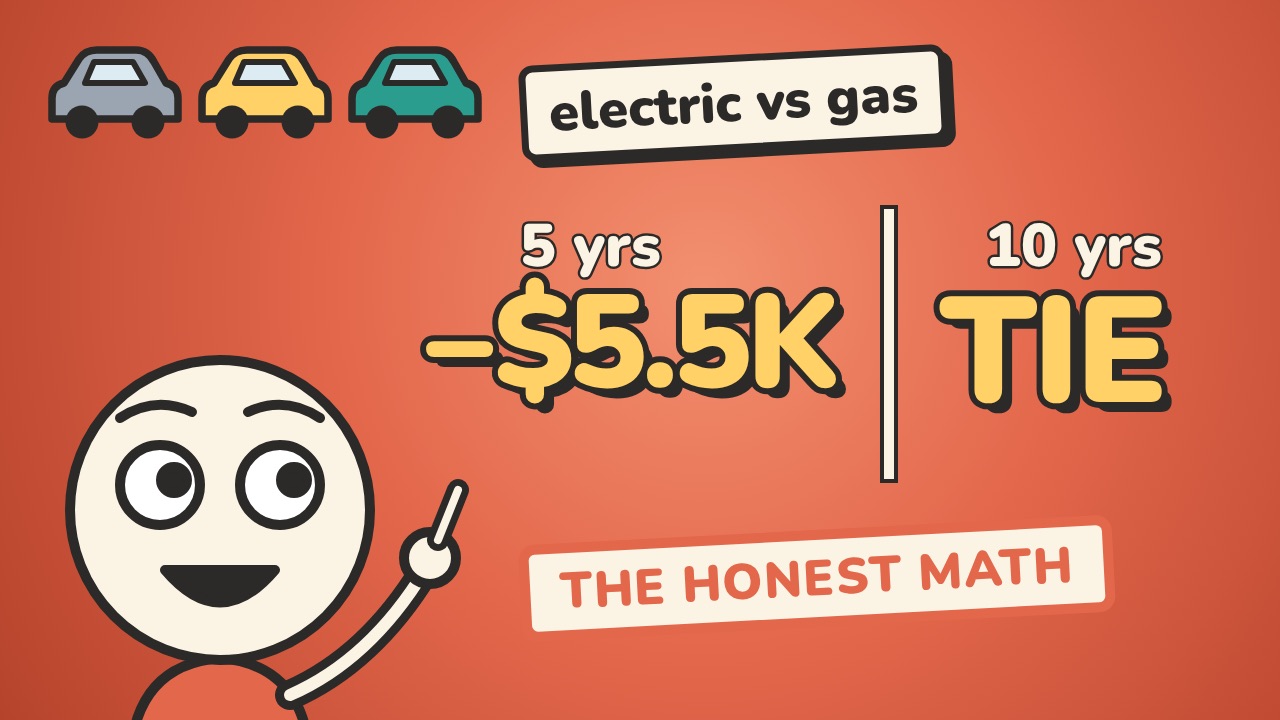
- Over 5 years, an average driver's EV with home charging costs about $5,500 more than gas. Over 10 years it's roughly a tie.
- No plug at home? The EV loses on energy too. A used EV with home charging can be the cheapest option of all.
Three cars. Same size, same class, same price range: a plain gas car, the hybrid version of the same car, and an affordable electric car.
Ask people which one saves you money and you'll get three confident answers. The hybrid, obviously. The gas car, it's the cheapest. The electric car, you never buy gas again.
Here's the thing: most comparisons you see stop at five years. That's exactly when a car has lost the most value. But most people keep their cars a lot longer than five years. So in this lesson we do the honest math twice, once for five years and once for ten, and you'll see something surprising. The answer can flip, just by keeping the same car longer.
The 5 buckets of what a car really costs
Most people look at two numbers: the price on the sticker and the price at the pump. But the real cost of a car is spread across five buckets:
- Value lost (depreciation). You buy the car for one price and sell it years later for less. For most new cars this is the biggest bucket of all, and it never shows up on a bill.
- Loan interest. Most people finance a car, and a more expensive car costs more interest.
- Energy. Gas or electricity.
- Taxes and fees. Sales tax, registration and, in many states, an extra yearly fee for electric cars.
- Insurance and maintenance.
To compare cars honestly, you need all five buckets, not just one.
Our three cars and the assumptions
Here are three generic cars with prices close to popular models today, including the destination fee. (No specific model is recommended.)
| Gas compact sedan | Hybrid version | Small electric car | |
|---|---|---|---|
| Price (incl. destination) | $24,300 | $26,150 | $29,000 |
| Efficiency | 35 mpg | 50 mpg | 28 kWh per 100 miles |
| 5-year depreciation | 40% | 40% | 57% |
Every car gets the same treatment: a 60-month loan at 6.9%, gas at about $4.33 a gallon (the AAA national average in October 2026) and home electricity at 18¢ per kWh.
One important change: the federal tax credit for new electric cars ended for vehicles acquired after September 30, 2025. So the electric car here gets no federal discount. Some states and utilities still offer rebates, so check yours.
To keep it simple, we treat insurance and maintenance as roughly equal for all three. Real quotes vary, so always get yours.
Energy: the cost to drive 100 miles
Start with the bucket everyone talks about:
| Car | Cost per 100 miles |
|---|---|
| Gas (35 mpg at $4.33) | about $12.40 |
| Hybrid (50 mpg at $4.33) | about $8.70 |
| Electric, charged at home (18¢/kWh) | about $5.00 |
| Electric, public fast charging (54¢/kWh) | about $15.10 |
At home, the electric car costs less than half as much as the gas car to drive. It's also quiet and quick, and it never needs an oil change. If energy were the whole story, this would be a very short lesson.
Gas vs hybrid: the mileage line
Start with the easier fight. The hybrid costs $1,850 more. Part of that comes back when you sell, because hybrids tend to hold their value well, but you also pay interest on the extra money and a bit more sales tax. Over five years, the hybrid starts about $1,200 behind.
The only thing that pays it back is fuel: the hybrid saves about $3.70 every 100 miles. So there's a line:
| Gas price | Hybrid beats gas over 5 years above about | Over 10 years above about |
|---|---|---|
| $4.33 a gallon (now) | 6,400 miles a year | 4,700 miles a year |
| $3.16 a gallon (a year earlier) | 8,800 miles a year | 6,500 miles a year |
The average American drives about 13,500 miles a year. So for most drivers, at today's gas prices, the hybrid wins. If you drive very little, the difference almost disappears, and when gas is cheaper the line moves up.
The electric car's depreciation wall
Now the electric car, and the part most people skip.
The price. The electric car costs about $4,700 more than the gas car. On the same loan, that's almost $900 of extra interest.
Depreciation. A large iSeeCars study of used-car sales found that the average electric car loses about 57% of its value in five years. Popular compact gas cars lose around 40%.
| Value lost in 5 years | Amount |
|---|---|
| Electric car (57% of $29,000) | about $16,600 |
| Gas car (40% of $24,300) | about $9,700 |
| Gap | almost $7,000 |
Picture that gap as a wall. Add the extra EV registration fee most states charge (around $155 a year on average), a little more sales tax and a home charger (roughly $1,700 installed), and before a single mile is driven the electric car starts about $10,500 behind over five years.
The energy savings have to climb that whole wall before the electric car saves you anything.
Where does your car sleep? Home vs public charging
There's a second question that has nothing to do with miles: where does your car sleep at night?
That $5-per-100-miles number only works if you charge at home. If you live in an apartment with no charger, you'll probably use public fast chargers, which averaged about 54¢ per kWh in 2026, three times the home price. At that price, 100 miles in the electric car costs about $15, more than the gas car's $12.40.
So without a plug at home, the electric car doesn't just lose its big advantage. It loses on energy too, on top of the wall. If your car sleeps next to a plug, the energy savings are real. If it doesn't, the electric car is fighting with both hands tied.
The 5-year results
Put all five buckets together for the average driver (13,500 miles a year) over five years, compared with the gas car:
| Over 5 years, vs the gas car | Difference |
|---|---|
| Hybrid | about $1,300 cheaper |
| Electric, charged at home | about $5,500 more expensive |
| Electric, public fast charging only | about $10,600 more expensive |
That matches what AAA found in its 2026 Your Driving Costs study: for medium sedans, the hybrid had the lowest cost per mile (about 68¢), gas was close behind (about 70.5¢) and the EV was highest (about 91¢), mostly because of depreciation.
At five years, the home-charged electric car only beats the gas car above about 28,000 miles a year, more than double what most people drive. If you stop the math at five years, the verdict is clear: hybrid for most people, electric only for very high mileage.
But here's the question nobody asks: who sells their car after five years?
Why 10 years changes the math
The average car on US roads is now about 12.8 years old. Most people drive a car much longer than five years, and that changes the math for one simple reason: depreciation isn't spread evenly.
A car loses the most value in its first few years. After that the drop slows, because there's less value left to lose. But energy savings don't slow down. They keep coming every mile, every year.
One honest note: today's electric cars are too new for reliable ten-year resale data. So we use a simple assumption and say it out loud: in years 6 to 10, every car loses about half of the value it had left at year 5. Same rule for all three cars.
The 10-year results: the answer flips
Here's what happens to the wall. Over ten years, the electric car's extra depreciation doesn't keep growing; it actually shrinks a little, to under $6,000, because by then all three cars are worth much less. Meanwhile, the energy savings double: charging at home saves the average driver about $1,000 a year compared with gas.
| Average driver, vs the gas car | 5 years | 10 years |
|---|---|---|
| Hybrid | about $1,300 cheaper | about $3,300 cheaper |
| Electric, charged at home | about $5,500 more | about $300 more (basically a tie) |
| Electric, public charging only | about $10,600 more | about $12,100 more |
And the break-even line moves:
| Electric (home charging) beats gas above about | 5 years | 10 years |
|---|---|---|
| At $4.33 gas | 28,600 miles a year | 13,900 miles a year |
| At $3.16 gas | 52,600 miles a year | 25,500 miles a year |
At ten years and today's gas price, the electric car needs about 14,000 miles a year to win, right around the average driver. Same cars, same prices; the only thing we changed was how long you keep it.
How gas and electricity prices move the lines
All these lines move with prices. Gas is unusually expensive right now; a year earlier it was about $3.16 a gallon, and at that price both the hybrid and the electric car take much longer to pay back (see the tables above).
Electricity moves the lines too. With solar panels or a cheap overnight rate from your utility, your cost per mile at home can be far below our $5. Where electricity is expensive, it's higher. And state rebates, or no extra EV fee where you live, shrink the wall.
So don't memorize our numbers. Remember the shape:
- Gas prices decide how fast the hybrid and the electric car pay back.
- Your plug decides whether the electric car is even in the race.
- Your time frame decides how much of the wall you have to climb.
Two drivers: Sam vs Alex
Sam drives about 7,000 miles a year, mostly around town, and lives in an apartment with no charger.
| Sam, vs gas | 5 years | 10 years |
|---|---|---|
| Hybrid | about $100 cheaper | about $850 cheaper |
| Electric (public charging only) | about $9,700 more | about $10,400 more |
Sam's honest answer: a hybrid or a plain gas car. Not electric, at least not until Sam has a plug.
Alex drives about 22,000 miles a year and has a garage with a plug.
| Alex, vs gas | 5 years | 10 years |
|---|---|---|
| Hybrid | about $2,900 cheaper | about $6,400 cheaper |
| Electric (home charging) | about $2,400 more | about $5,900 cheaper |
For Alex, keeping the car ten years makes electric and hybrid nearly a tie, so electric is a real option. Same cars, different lives, different answers.
Option 4: a used electric car
There's one more option most comparisons skip: a used electric car. Remember the wall? The steepest depreciation lands on the first owner. Buy a five-year-old EV and someone else has already paid for that drop.
Say an average driver buys each of our cars at five years old and keeps it five more years. Using the same assumptions:
| Used car (5 years old) | Purchase price | Depreciation + energy + fees over 5 years |
|---|---|---|
| Used electric (home charging, incl. charger) | about $12,400 | about $12,100 |
| Used hybrid | about $15,700 | about $13,700 |
| Used gas | about $14,600 | about $15,600 |
The used electric car comes out about $3,500 cheaper than the used gas car and about $1,600 cheaper than the used hybrid. Before you buy, check two things:
- The battery warranty. Most EV batteries are covered for about 8 years or 100,000 miles. Know how much is left.
- The plug. Without home charging, this advantage disappears too.
What this comparison is (and isn't)
This isn't a verdict on electric cars as a technology. It's the money side of one decision: buying one of these three cars today, at today's prices.
There are reasons to choose a car that aren't on any spreadsheet: how it drives, how quiet it is, the environment, never stopping at a gas station. Those are real, and they're yours to weigh. The goal isn't to tell you which car to love. It's to make sure that when you sign, you know what each choice really costs over the years you'll actually own it.
3 car-buying mistakes
1. Comparing only the sticker price, or only the pump. Depreciation is usually the biggest bucket, and it never sends you a bill.
2. Buying an electric car without a plug at home. Public fast charging can cost more per mile than gas.
3. Judging a car over five years when you'll really keep it for ten. Decide how long you'll keep it before you compare. It can change the winner.
Your map: 3 questions
- Where will the car sleep? If there's no plug you can use at home prices, the choice is between gas and hybrid.
- How far do you drive? At today's gas prices, above roughly 6,500 miles a year the hybrid usually beats gas.
- How long will you keep it? If you charge at home and keep the car around ten years, an electric car can catch up, especially if you drive more than average or buy it used.
Your exact numbers will differ (gas prices, electricity rates, state fees and rebates all move the lines), but the shape of the answer holds. Next, the other half of the decision: lease, finance or pay cash?
Three things to do before your next car
- Write down your yearly miles. Your last two service receipts or your odometer will tell you.
- Answer the plug question honestly. Where would you charge, and at what price per kWh?
- Pick your time frame, five years or ten, then compare all five buckets, not just the sticker.
Frequently asked questions
Is a hybrid cheaper than a gas car?
For most drivers at today's gas prices, yes. In our comparison, a hybrid that costs $1,850 more than its gas version pays for itself above roughly 6,400 miles a year over five years at $4.33 a gallon. The average American drives about 13,500 miles a year. At lower gas prices, the break-even mileage rises.
Is an electric car cheaper to own than a gas car?
It depends on charging and time frame. Charged at home, an EV costs about $5 per 100 miles vs about $12.40 for a 35-mpg gas car. But EVs have depreciated faster (about 57% in five years on average), so over five years our average driver paid about $5,500 more. Over ten years the costs were roughly equal, and higher-mileage drivers came out ahead.
How much does it cost to charge an electric car vs gas?
At 18 cents per kWh at home, an EV using 28 kWh per 100 miles costs about $5 per 100 miles. At public fast chargers averaging about 54 cents per kWh, it's about $15. A 35-mpg gas car at $4.33 a gallon costs about $12.40 per 100 miles.
Why do electric cars depreciate so fast?
Reasons include rapid improvements in new models and battery technology, price cuts on new EVs, the end of federal tax credits and buyer uncertainty about battery life. An iSeeCars study found the average EV lost about 57% of its value over five years, compared with roughly 40% for popular compact gas cars.
Is a used electric car worth it?
It can be, because the first owner absorbs the steepest depreciation. In our comparison, a five-year-old EV kept for five more years with home charging cost about $3,500 less than a used gas car. Check the remaining battery warranty and make sure you can charge at home.
Is there still a federal tax credit for electric cars?
No. The federal clean vehicle credit ended for vehicles acquired after September 30, 2025. Some states and utilities still offer rebates or incentives, so check what's available where you live.
Assumptions and sources
Generic cars with prices close to popular models, including destination: compact gas sedan $24,300, hybrid version $26,150, small EV $29,000. Federal clean vehicle credit ended for vehicles acquired after September 30, 2025. 60-month loan at 6.9% APR. Gas $4.33 a gallon (AAA national average, October 2026; $3.16 a year earlier). Home electricity $0.18/kWh (AAA 2026 Your Driving Costs); public DC fast charging $0.538/kWh (Paren, Q2 2026). Efficiency: 35 mpg, 50 mpg and 28 kWh per 100 miles. Five-year depreciation: average EV 57.2% (iSeeCars 2026 study); gas and hybrid compacts assumed 40%. Years 6 to 10: every car assumed to lose half of its remaining value. EV fee $155 a year (average extra EV registration fee among states that charge one); home charger about $1,700 installed (estimate); sales tax 6% on price differences. Insurance and maintenance treated as roughly equal. Average driver about 13,500 miles a year (FHWA). AAA 2026 Your Driving Costs, medium sedan at 15,000 miles a year: hybrid $0.680, gas $0.705, EV $0.911 per mile. Average age of US vehicles 12.8 years (S&P Global Mobility). Used-car comparison excludes loan interest. All results are calculated estimates; your numbers will differ. No car model is recommended.
One new lesson every week
Each lesson builds on the one before. Subscribe on YouTube so you don't miss the next one.
Subscribe on YouTube See all lessonsKeep learning

Lesson 11 · Big Money Decisions
Lease, Finance or Pay Cash? The Honest Math of Your Next Car
Same $30,000 car, same day at the dealership: lease it, finance it or pay cash? We follow all three for 3, 6 and 10 years, and the gap at the end is about $30,000.

Lesson 12 · Big Money Decisions
Renting vs Buying a Home: Who Actually Wins? The Honest Math
"Renting is throwing money away." Is it? We follow a buyer and a renter with the same income and savings for 30 years, using today's rates and every real cost, and show the three conditions that actually decide the winner.

Lesson 7 · Investing
Compound Interest Explained: Why $25 a Week Becomes $284,000
$25 a week, invested for 40 years, could grow to about $284,000 even though you only put in $52,000. Here's the curve behind it, and why the first ten years feel like nothing is happening.