
Lesson 11 · Big Money Decisions · 12 min read
Lease, Finance or Pay Cash? The Honest Math of Your Next Car
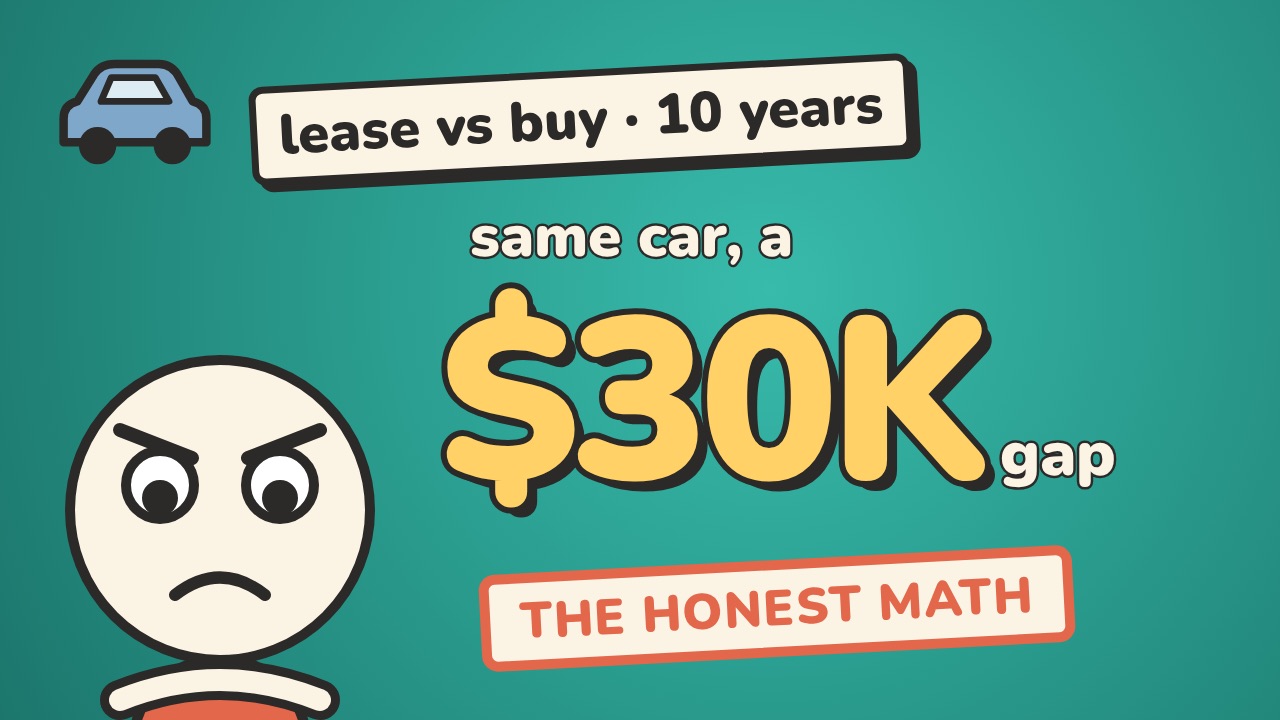
Same $30,000 car, same day at the dealership: lease it, finance it or pay cash? We follow all three for 3, 6 and 10 years, and the gap at the end is about $30,000.
Updated
The lesson in 30 seconds
- Leasing is renting: you pay for the car's steepest years of depreciation and own nothing at the end. Financing has a finish line. Cash starts at the finish line.
- On a $30,000 car, the lease payment (about $430) looks cheaper than the loan (about $535), but by year 3 the buyer already owns about $6,000 of car.
- Over 10 years, leasing costs about $68,000 vs about $38,000 for financing and keeping the car: a gap of about $30,000.
- Watch for 84-month loans and negative equity: almost 30% of trade-ins are underwater, by about $6,900 on average.
- Ask for the out-the-door price, not the monthly payment. After the loan ends, keep paying yourself into a car fund.
Same car, same price, same day at the dealership, three ways to pay for it.
Alex leases it: a low monthly payment and a brand-new car every three years. Sam finances it: a bigger payment, but one day the car is Sam's. And the third way: pay cash and never see a car payment at all.
Ask the dealer which is the best deal and the answer will almost always be about one number: the monthly payment. But the monthly payment is the number that hides the most. So in this lesson we follow all three options for three, six and ten years, and by the end the gap between them is bigger than most people would guess.
The 3 ways to pay, explained
Leasing means renting the car. You pay for the part of its value you use up during the lease, plus a kind of interest, plus fees. At the end you hand back the keys. You never own it.
Financing means borrowing money to buy the car and paying the loan back with interest. Every payment buys you a bigger piece of it, and when the loan ends, it's yours.
Paying cash means you own it from day one: no payments and no interest. But that money is gone from your savings.
The simplest way to picture it: leasing is a conveyor belt, financing is a race with a finish line, and paying cash means you start at the finish line.
The deal: same $30,000 car
Let's make it concrete with a $30,000 compact sedan:
| Alex: lease | Sam: finance | |
|---|---|---|
| Term | 36 months | 60 months |
| Due at signing / down payment | about $2,000 | $3,000 |
| Monthly payment | about $430 | about $535 |
| Mileage limit | 12,000 a year | none |
| Rate | money factor 0.0025 (about 6% APR) | 7.0% APR (about the national average) |
Sam pays about $100 a month more, and it feels like a lot. Alex drives off with lower payments and a full warranty and feels like the smart one.
For scale: the average new-car loan payment in the US is now about $787 a month (Edmunds, Q3 2026). Our example is a modest car.
Why lease payments look so low
Why is the lease payment so much lower? Because of how it's calculated.
At the start, the leasing company predicts what the car will be worth at the end, the residual value. For Alex's car, say 60%, or about $18,000 after three years. Alex's payments mostly cover the difference: the car loses about $12,000 of value in those three years, and Alex pays for that drop spread over 36 months. On top of that comes a charge that works like interest, called the money factor, and then fees.
Sam's payments, by contrast, cover the whole price of the car plus interest, in five years.
So Alex isn't getting a cheaper car. Alex is paying for a smaller piece of it: the most expensive piece, the first three years, when a car loses value fastest. That's why the lease payment looks so friendly, and why at the end Alex has nothing left to sell.
Scoreboard: 3 years
After three years:
- Alex has paid $2,000 at signing plus 36 payments, a $400 fee for turning the car in, and a charge for going over the mileage limit. The average American drives about 13,500 miles a year, so Alex went over by about 4,500 miles at 25¢ each. Total: about $20,200.
- Sam has paid $3,000 down plus 36 loan payments: about $23,400 (including maintenance).
Out of pocket, Alex is ahead by more than $3,000. That's the part everyone sees. Here's the part they don't: Sam's car is worth about $18,000 and Sam owes about $12,000 on the loan, so Sam owns about $6,000 of car. Alex owns nothing.
| After 3 years | Spent | Car equity | Real cost |
|---|---|---|---|
| Lease (Alex) | about $20,200 | $0 | about $20,200 |
| Finance (Sam) | about $23,400 | about $6,100 | about $17,400 |
| Cash | about $31,200 | $18,000 | about $13,200 |
Count the equity and Sam is already ahead, just quietly.
The conveyor belt vs the finish line
Alex's lease is over, and Alex has three choices: buy the car at a price set at the start of the lease, walk away with nothing, or lease a brand-new car and start again.
Most people in Alex's position lease again: another $2,000 at signing, another 36 payments. The payment counter resets to month one.
Sam still has two years of payments left, which is frustrating. But Sam has an end date circled on the calendar. Every payment brings Sam closer to owning the car; every payment Alex makes brings Alex closer to giving a car back. That's the conveyor belt: the ride feels smooth, but it never ends.
Scoreboard: 6 years
Alex has finished two full leases: about $40,300 spent, with nothing to show for it except receipts.
Sam made the last payment at the end of year five. From then on Sam pays only for insurance, gas and maintenance, and maintenance does go up once the warranty ends (we count about $1,000 a year from year four).
| After 6 years | Spent | Car equity | Real cost |
|---|---|---|---|
| Lease (Alex) | about $40,300 | $0 | about $40,300 |
| Finance (Sam) | about $39,300 | about $13,500 | about $25,800 |
| Cash | about $34,200 | about $13,500 | about $20,700 |
Sam has spent almost the same as Alex, but owns a car still worth around $13,500. The gap is now about $14,500.
Scoreboard: 10 years (a ~$30,000 gap)
Alex is in the middle of a fourth lease. Sam is still driving the same car. It's older and repairs cost more now (we count about $1,500 a year from year seven), but it's still worth around $7,500.
| After 10 years | Spent | Car equity | Real cost |
|---|---|---|---|
| Lease (Alex) | about $68,000 | $0 | about $68,000 |
| Finance (Sam) | about $45,300 | about $7,500 | about $37,800 |
| Cash | about $40,200 | about $7,500 | about $32,700 |
That's a gap of about $30,000 between leasing and financing for the same kind of car over the same ten years.
To be fair, Alex got something for that money: a newer car every three years, almost always under warranty. That's real. The question is whether it's worth about $3,000 a year to you.
The lease fine print
That was the clean version of the lease. Here's the fine print that rarely makes the ad:
- Mileage limits. Many leases allow 10,000 to 15,000 miles a year. Go over and you typically pay 10¢ to 30¢ per extra mile, all due at the end.
- Wear and tear. At return, the car is inspected. Deep scratches, stained seats, curbed wheels and worn tires can each be a charge, and the leasing company decides what counts as normal.
- Fees. Many leases charge an acquisition fee at the start (often $395 to $895) and a disposition fee at the end (often $300 to $500), just for turning the car in.
- Getting out early can be very expensive. If your life changes mid-lease, you may owe a big part of the remaining payments.
None of this shows up in the monthly payment.
Loan traps: 84-month loans and negative equity
Financing has its own traps.
Trap 1: the very long loan. In Q3 2026, about one in four new-car buyers (25.5%) took a loan of 84 months or more: seven years. On Sam's car:
| Same $27,000 loan at 7% | 60 months | 84 months |
|---|---|---|
| Monthly payment | about $535 | about $408 |
| Total interest | about $5,080 | about $7,230 |
| Still owed after 3 years | about $11,900 | about $17,000 |
The 84-month payment is even lower than Alex's lease, but Sam would pay over $2,100 more interest, and after three years would still owe about $17,000 on an $18,000 car.
Trap 2: negative equity. That's when you owe more on the car than it's worth. In Q2 2026, 29.6% of trade-ins had negative equity, and the average amount was about $6,900. Most of it doesn't disappear; it's rolled into the next loan. A bigger loan, a bigger payment and more interest: a different conveyor belt, but still a conveyor belt.
At the dealer: ask for the out-the-door price
How do you avoid both traps? Change the question you ask.
The salesperson will often start with "What monthly payment are you looking for?" That question lets them adjust everything else: a longer loan, a bigger lease, extra add-ons, and the payment still looks fine.
Instead, ask for the out-the-door price: the total price of the car with taxes and every fee included, before you talk about how you'll pay. Agree on that number first. Then compare lease, loan and cash by their total cost over the years you'll keep the car.
Also watch for add-ons slipped into the financing: extended warranties, paint protection and similar extras can add hundreds or thousands of dollars, and then you pay interest on them too.
Paying cash vs a loan vs investing
If Sam had paid the full $30,000 up front, there would be no loan and no interest. Over ten years that saves roughly $5,000, and Sam's real cost drops from about $37,800 to about $32,700.
But what if Sam invested that money instead, like in Lesson 9? At 7%, paying off a car loan is like earning a guaranteed 7%. An index fund might average about 7% a year, but with ups and downs and no guarantee. So at today's loan rates, paying cash or making a big down payment usually wins.
There's one exception: 0% financing. Then the loan costs you nothing, and you could keep your cash in a high-yield savings account earning around 4%. On Sam's car, $27,000 kept in savings while paying $450 a month could earn roughly $3,100 over five years, but only if you actually leave that money alone.
And one rule above all: never empty your emergency fund to pay cash for a car (Lesson 5). The car can wait. The emergency can't.
When leasing can make sense
Leasing isn't always a mistake. It can make sense if:
- You use the car for a business. Part of the lease may be tax-deductible; talk to a tax professional before counting on it.
- You drive very little, stay well under the mileage limit and truly want a new car every few years, with predictable costs.
- You're looking at a luxury car, where out-of-warranty repairs can be brutal, so staying under warranty has real value.
- The buyout is a bargain. Sometimes the end-of-lease buyout price is lower than what the car is actually worth.
But for most people, driving an ordinary car an ordinary amount, buying and keeping it costs less. Often a lot less.
Pay yourself the car payment
Here's the move that gets you off every conveyor belt for good: pay yourself the car payment.
When Sam makes the last loan payment, nothing about Sam's budget changes. Sam keeps sending $535 a month, but now into a separate savings account, a car fund. After five more years at around 4% interest, that fund holds about $35,400: enough to buy the next car in cash. No loan, no interest, no negative equity, and Sam's old car can be sold or traded in on top.
The first car is the hard one. After that, the payment you were already used to keeps working, but this time for you. (It's the same pay-yourself-first habit from the budgeting lesson.)
Which one fits you?
| Your situation | Usually the better fit |
|---|---|
| You'll keep the car 5+ years and drive an average amount or more | Buy: pay cash or put a lot down, and keep the loan to 5 years or less |
| You want a new car every few years, drive well under the limit and accept a permanent payment | Lease, knowing it costs about $3,000 a year more in our example |
| The dealer offers 0% financing and you have the cash anyway | Take the 0% loan, keep the cash safe and earning interest |
| The payment only fits on a 7-year loan | A cheaper car, new or used |
And if you haven't chosen the car yet, gas, hybrid or electric? shows how the type of car changes the total cost too.
3 car-payment mistakes
1. Shopping by the monthly payment. Always ask for the total cost over the whole time you'll have the car.
2. Stretching the loan to make the payment fit. If you need seven years to afford it, the car is probably too expensive.
3. Leasing while driving more than the mileage limit. Those cents per mile add up to real money at the end.
Three things to do before your next car
- Decide how long you'll keep it. If it's more than five years, buying almost always beats leasing.
- Get a loan offer from your bank or credit union before you go to the dealer, so you know what a fair rate looks like.
- If you already have a car loan, start your car fund the month it ends. Same payment, new destination.
Frequently asked questions
Is it better to lease or buy a car?
For most people who keep a car five years or longer and drive an average amount, buying is cheaper. In our $30,000 example, leasing for 10 years cost about $68,000 while financing and keeping the car cost about $38,000 after counting the car's remaining value. Leasing can make sense for low-mileage drivers who want a new car every few years, or for some business use.
Why are lease payments lower than loan payments?
Because a lease covers only the car's expected loss in value during the lease, plus a finance charge (the money factor) and fees, while a loan pays off the whole price of the car. You're paying for the most expensive years of depreciation and own nothing at the end.
Is it better to pay cash for a car or finance it?
At typical new-car rates around 7%, paying cash or making a large down payment usually saves money, because avoiding the interest is a guaranteed return. With a true 0% offer, financing and keeping your cash in a high-yield savings account can come out ahead. Never use your emergency fund to pay cash for a car.
Is an 84-month car loan a bad idea?
Usually, yes. It lowers the payment but increases total interest and keeps you owing more than the car is worth for longer. In our example, stretching a $27,000 loan at 7% from 60 to 84 months added about $2,100 of interest, and after three years about $17,000 was still owed on an $18,000 car.
What is negative equity on a car?
Negative equity means you owe more on your car loan than the car is worth. In Q2 2026, about 29.6% of trade-ins had negative equity, averaging about $6,900, according to Edmunds. Rolling it into a new loan makes the next loan bigger and more expensive.
What does out-the-door price mean?
The out-the-door price is the total you'll pay for the car including taxes, title, registration and all dealer fees. Negotiating this number first, before discussing monthly payments or financing, makes it much harder for costs to be hidden in a longer loan or add-ons.
Assumptions and sources
Illustrative $30,000 compact sedan. Lease (typical terms, calculated): 36 months, 12,000 miles a year, $2,000 due at signing, 60% residual, money factor 0.0025, about $430 a month; $400 disposition fee; 13,500 miles a year driven (FHWA average), so 4,500 miles over at $0.25. Loan: $3,000 down, 7.0% APR (Edmunds Q3 2026 average new-car APR), 60 months, about $535 a month. Car values (estimates): $18,000 (year 3), $13,500 (year 6), $7,500 (year 10). Maintenance (estimates): $400 a year while new; $1,000 a year in years 4 to 6; $1,500 a year in years 7 to 10. Insurance and gas treated as equal. Average new-car loan payment $787 a month and 25.5% of new-car loans at 84+ months (Edmunds Q3 2026). Negative equity: 29.6% of trade-ins, average $6,884 (Edmunds Q2 2026). Lease fees: acquisition $395 to $895, disposition $300 to $500, excess mileage $0.10 to $0.30 a mile. 0% example: $27,000 kept in a high-yield savings account at about 4% APY. Car fund: $535 a month for 5 years at 4%, about $35,400. All results are calculated estimates; your numbers will differ. No dealer, lender or car model is recommended.
One new lesson every week
Each lesson builds on the one before. Subscribe on YouTube so you don't miss the next one.
Subscribe on YouTube See all lessonsKeep learning
Lesson 10 · Big Money Decisions
Gas, Hybrid or Electric? What a Car Really Costs Over 5 vs 10 Years
Most comparisons stop at five years, right when a car has lost the most value. We run the honest math for 5 and 10 years, and show why the answer can flip just by keeping the same car longer.
Lesson 12 · Big Money Decisions
Renting vs Buying a Home: Who Actually Wins? The Honest Math
"Renting is throwing money away." Is it? We follow a buyer and a renter with the same income and savings for 30 years, using today's rates and every real cost, and show the three conditions that actually decide the winner.
Lesson 8 · Budgeting & Planning
The Smartest Order to Use Your Money: From Paycheck to Portfolio, Step by Step
You have $400 left over this month. Pay the card, save it or invest it? The order matters more than you think: skipping one free step at work can cost about $152,000 by retirement.